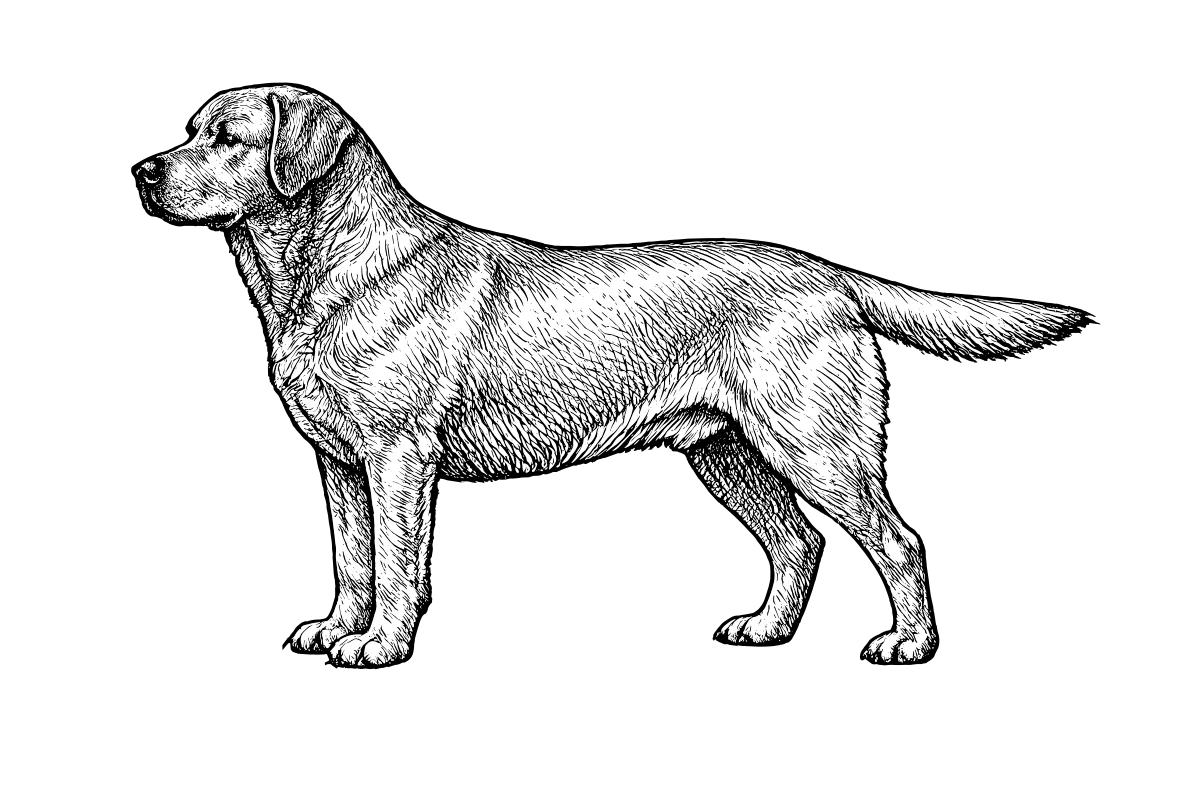
Labrador Retriever
Sporting group · Newfoundland, Canada (refined in 19th-century England)
The most popular dog in the United States for over thirty consecutive years. Bred from fishermen's water dogs into the modern world's default retriever — equally suited to a duck blind and a kitchen floor.
Browse the Woodcut Wild shop →Origin & history
The breed descends from the St. John's water dog, a working dog used by 19th-century cod fishermen in Newfoundland to retrieve fish and tow lines through icy Atlantic water. English aristocrats — chiefly the Earl of Malmesbury and the Duke of Buccleuch — imported them in the 1830s and refined the breed for upland game retrieval. The St. John's dog itself went extinct by the 1980s. The Labrador, its closest descendant, has been the most-registered breed in the AKC since 1991.
Temperament & behavior
Labradors are biddable, food-motivated, and eager to work — qualities that make them the dominant breed in guide-dog programs, scent-detection units, and field trials. They retain a juvenile temperament well past physical maturity and tend to be indiscriminately social. Without daily exercise and mental work they can become destructive; with it, they are nearly inexhaustible.
Originally bred for
Retrieving waterfowl and net-fish for cod fishermen off the Newfoundland coast.
Marginalia
- Their otter-like tail acts as a rudder when swimming — thick at the base, tapered, and carried straight.
- A waterproof double coat and webbed toes are direct holdovers from the Newfoundland water-dog ancestry.
- The breed was nearly lost in the 1880s when Newfoundland imposed taxes on dog ownership and the UK quarantined imports.
- Yellow Labs were considered defective until the early 20th century — black was the only accepted color until 1899.
Related breeds
Common questions
Do Labrador Retrievers shed?
Constantly, despite the short coat. The dense, waterproof double coat sheds year-round and dumps undercoat heavily twice a year; the hairs are short, stiff, and excellent at embedding in fabric and carpet. Weekly brushing — daily during a seasonal blow — keeps it manageable, but a Lab is a poor choice for anyone hoping to keep a hair-free house.
Are Labrador Retrievers good with kids and other pets?
About as good as a dog gets, which is why they top the family lists year after year. Labs are patient, sturdy enough to survive a boisterous household, and indiscriminately fond of people and animals alike — most get on with dogs and cats without fuss. The retrieving instinct is soft-mouthed rather than predatory, so small pets are usually safe. The main hazard is exuberance: an under-exercised young Lab is a knock-children-over machine, not from temper but from sheer momentum.
What health problems are Labrador Retrievers prone to?
Chiefly joints and weight. The breed is prone to hip and elbow dysplasia, and obesity is rampant — Labs carry a genetic mutation (in the POMC gene) that blunts the feeling of fullness, so they will eat themselves overweight given the chance. They are also predisposed to exercise-induced collapse and to certain eye conditions; keeping the dog lean does more for its lifespan than almost anything else.
How much exercise do Labrador Retrievers need?
A lot, and it does not shrink to fit your schedule. Figure on an hour or more of hard activity a day — a run, a swim, a long fetch session — because the breed was built to work a full day in cold water and retains the engine. A well-exercised Lab is calm and biddable indoors; an under-exercised one turns destructive and restless, and the difference between the two dogs is almost entirely the morning's exertion.
Are Labrador Retrievers good for first-time owners?
One of the safest first dogs there is, with the energy as the catch. The temperament is forgiving and the breed is famously trainable, so a novice's mistakes rarely harden into real problems. What first-timers underestimate is the exercise, the long boisterous adolescence, and the relentless appetite — a Lab needs structure around food and activity, and given that, it is hard to go wrong.