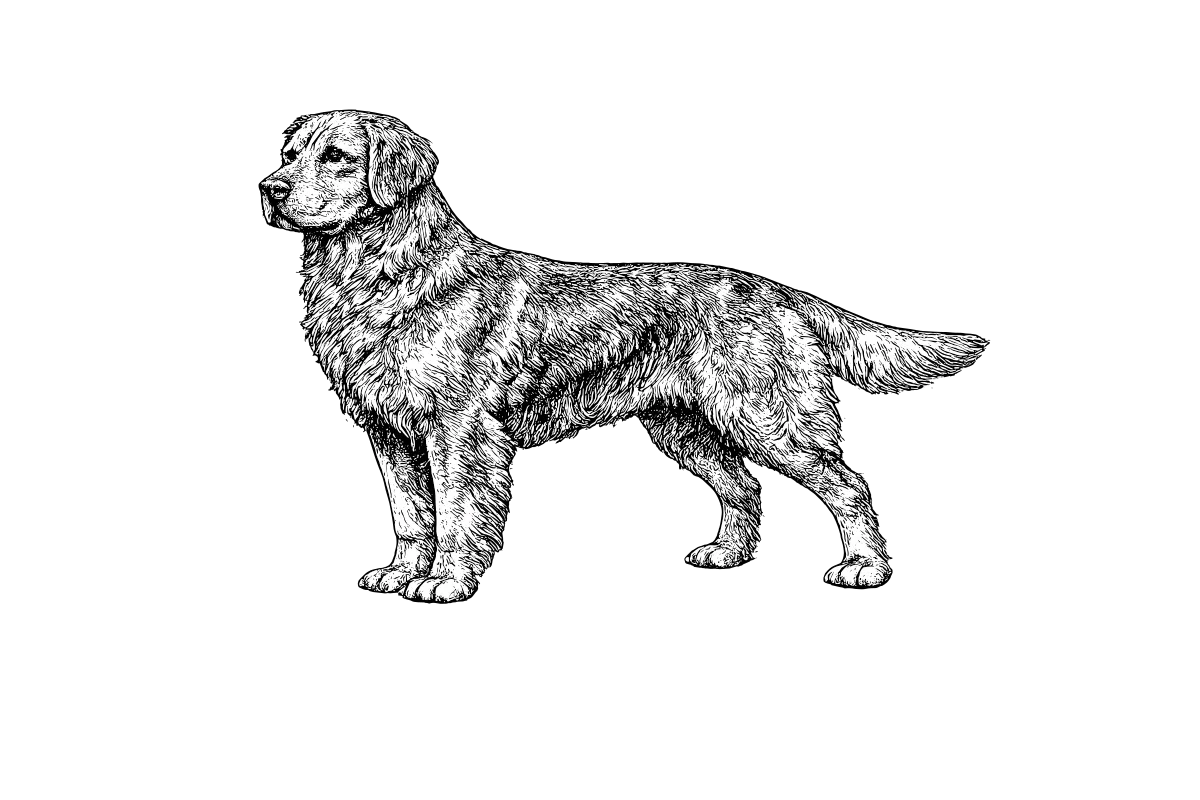
Golden Retriever
Sporting group · Scottish Highlands, 1860s (Sir Dudley Marjoribanks, Lord Tweedmouth)
A breed engineered for a specific 19th-century problem: shooting grouse and waterfowl from a Highland estate produced birds that fell across water and rough cover, and the existing retrievers weren't good enough. The Golden Retriever was the solution — and it was so good at the new job, and so easy to live with, that it long outlasted the sport that created it.
Browse the Woodcut Wild shop →Origin & history
The breed's pedigree is unusually well-documented because Lord Tweedmouth kept detailed studbooks at his Guisachan estate in the Scottish Highlands from 1868 onward. The foundation cross was a yellow Wavy-Coated Retriever named Nous, bred with a Tweed Water Spaniel (now extinct) named Belle. Subsequent generations introduced Irish Setter, Bloodhound, and additional Tweed Water Spaniel blood. The breed was developed over roughly fifty years and shown publicly for the first time as a distinct type in 1908. The Kennel Club recognized it as a separate breed in 1913. American imports began in the 1920s and the breed has been one of the top ten most-popular AKC breeds continuously since the 1970s.
Temperament & behavior
Golden Retrievers are perhaps the most reliably even-tempered breed in widespread use — the trait was selected for at the founding and has been preserved. They are highly food-motivated and biddable; they retrieve obsessively; they swim with enthusiasm; they form attachments to children with unusual reliability for a large dog. The breed mouths things constantly — most Goldens carry an object in their mouth at all times when greeting people. They are also genetically prone to several cancers (hemangiosarcoma, lymphoma, mast cell tumors) at significantly higher rates than the dog population at large; the Morris Animal Foundation's Golden Retriever Lifetime Study is one of the largest active veterinary research projects for this reason.
Originally bred for
Retrieving downed waterfowl from the lochs and rivers of the Scottish Highlands.
Marginalia
- All modern Golden Retrievers descend from a small number of Tweedmouth's dogs — the studbook closes at six original lineages.
- The 'English Cream' Golden marketed as a separate variety is genetically the same breed, just lighter-coated; the AKC does not recognize 'English Cream' as a distinct type.
- Goldens were the dominant breed in early service-dog and guide-dog programs in the United States, and remain in heavy use as therapy and emotional-support dogs.
- The breed has the highest documented cancer rate of any AKC breed — roughly 60% of Goldens die of cancer in the United States, twice the rate of dogs in general.
Related breeds
Common questions
Do Golden Retrievers shed?
Heavily, and all year. The water-repellent double coat sheds steadily day to day and blows out the undercoat in great drifts twice a year, in spring and fall. Daily brushing during a coat blow keeps the worst off the floor but nothing stops it; the feathering on the legs and tail also mats and needs combing. A low-shedding dog this is not.
Are Golden Retrievers good with kids and other pets?
Yes, about as reliably as any breed on both counts. The trait was selected for at the founding — Goldens bond to children with unusual steadiness, and the same indiscriminate friendliness extends to cats and other dogs given a normal introduction. The retrieving instinct is soft-mouthed rather than predatory, so small pets are usually safe, though an excitable young dog will chase what runs and can bowl a small child over from sheer momentum.
What health problems are Golden Retrievers prone to?
Cancer, above all — this is the breed's defining health concern. Goldens develop hemangiosarcoma, lymphoma, and mast cell tumors at markedly higher rates than dogs in general, which is why the breed anchors one of the largest active veterinary research studies. They are also prone to hip and elbow dysplasia and to certain eye and heart conditions; a breeder who health-tests the parents is worth seeking out, though it cannot fully offset the cancer risk.
How much exercise do Golden Retrievers need?
A great deal — figure on an hour or more of real activity a day. They were built to work a full day retrieving across water and cover, and that engine does not idle well. A swim or a long fetch session satisfies them better than a walk; a Golden left under-exercised gets restless, mouthy, and inventive about destruction.
Are Golden Retrievers good for first-time owners?
One of the best choices there is, with two caveats. The temperament is forgiving and the breed is eager to please, so training mistakes rarely curdle into real problems. But first-timers underestimate the grooming, the exercise, and the long puppyhood — Goldens stay mentally adolescent for two to three years — and they should go in clear-eyed about the breed's high cancer risk.