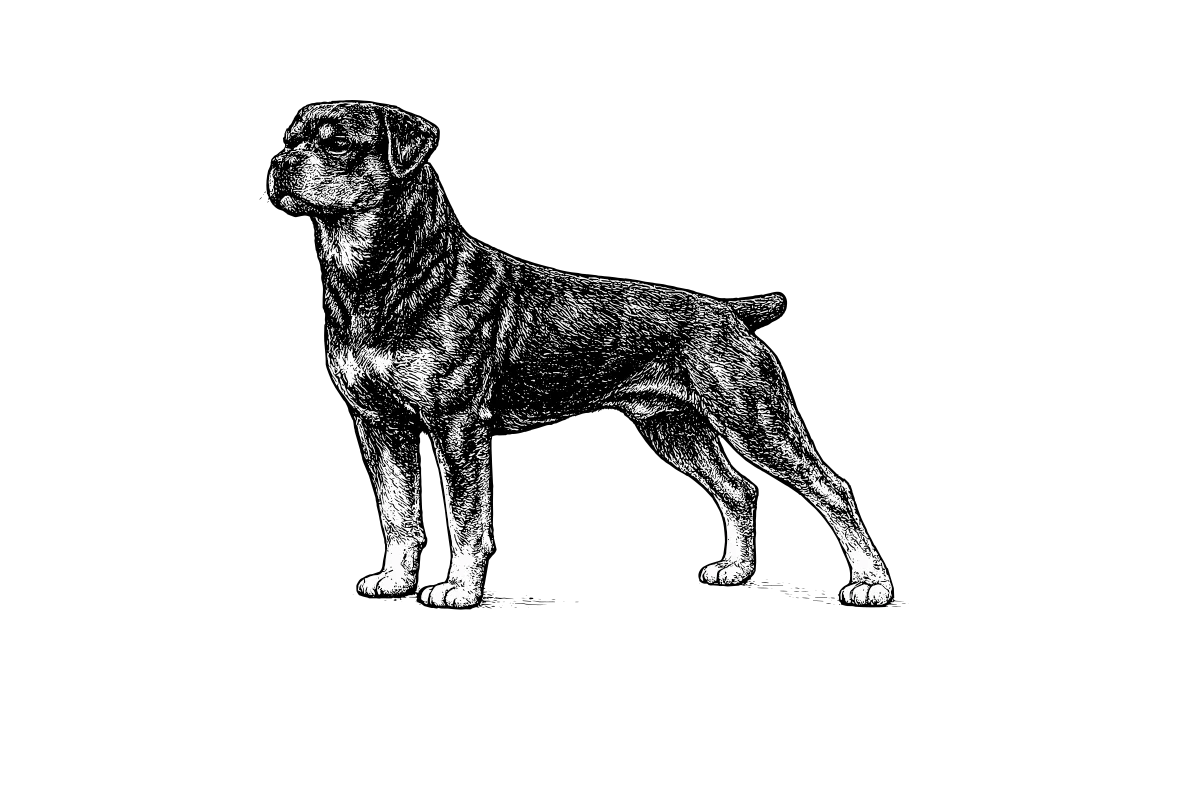
Rottweiler
Working group · Rottweil, Germany (Roman drover-dog ancestry, ~2,000 years)
The dog of the Roman drovers. The Rottweiler descends from mastiff-type cattle dogs the Roman legions brought across the Alps two thousand years ago, and the breed has been doing essentially the same job — moving livestock and protecting valuables — ever since.
Browse the Woodcut Wild shop →Origin & history
The breed's distant ancestors were drover dogs accompanying the Roman army across the Alps in the 2nd century, used to herd the cattle that fed the legions. When Roman occupation receded from southern Germany, the dogs remained and were absorbed into the local working-dog population, becoming particularly associated with the town of Rottweil — a major medieval cattle-trading center. The breed became known as the 'Rottweiler Metzgerhund' (Rottweil butcher's dog) for its primary duty: driving cattle to market, then guarding the cash the butcher carried home. The breed nearly went extinct in the mid-19th century when cattle droving was outlawed in favor of railway transport, and was rebuilt in the early 20th century when it found new work as a police and military dog. The breed standard was finalized in 1901.
Temperament & behavior
Rottweilers are not the volatile dog of public reputation — the working standard explicitly calls for a calm, confident, watchful temperament, not an aggressive one. The breed's reactivity is selective and discriminating: a properly bred Rottweiler ignores normal stimuli and intervenes only when its read of a situation says to. They are physically heavier than they look — a male standing alongside a Labrador weighs nearly twice as much — and bite force studies place them in the top three breeds measured. They are also unusually prone to bone cancer (osteosarcoma) and rarely live past eleven.
Originally bred for
Driving cattle to market and guarding the butcher's purse on the return journey.
Marginalia
- The breed's traditional working name 'Metzgerhund' is still preferred in parts of southern Germany.
- Rottweilers were one of the first dog breeds used as police dogs in Germany, predating the German Shepherd in that role.
- The breed traditionally carried the butcher's daily takings in a small purse strapped to its collar — robbing a Rottweiler-escorted butcher was understood to be a poor career choice.
- Genetic studies place the Rottweiler closer to the ancient Molossian war dogs of the eastern Mediterranean than to any northern European mastiff line.
Related breeds
Common questions
Do Rottweilers shed?
More than the short black coat lets on. Rottweilers are double-coated and shed moderately year-round with two heavier seasonal sheds in spring and fall. Grooming is otherwise minimal — a weekly brush with a rubber curry tool lifts the loose hair and keeps the coat glossy. They are not a low-shedding breed despite the deceptively tidy appearance.
Are Rottweilers good with kids and other pets?
Good with their own family's children, where the breed is famously steady and protective, and workable with other animals given proper socialization. Raised alongside a cat or dog, a Rottweiler typically accepts it as part of its territory. The cautions are real, though: the bulk can bowl a small child over and the herding heritage produces a body-leaning, shoulder-bumping habit, and same-sex dog aggression is a known tendency — so introductions to strange dogs should be careful and managed.
What health problems are Rottweilers prone to?
Bone cancer, joints, and heart. The breed is unusually prone to osteosarcoma — an aggressive bone cancer that is a leading cause of early death and a major reason Rottweilers rarely live past eleven. They are also predisposed to hip and elbow dysplasia and to heart conditions including aortic stenosis, and the deep chest carries some bloat risk. A breeder who screens hips, elbows, and heart is worth insisting on.
How much exercise do Rottweilers need?
A moderate, steady amount — they are working dogs, not sprinters. Two good walks a day plus some training or a job to do keeps a Rottweiler settled; they are calm in the house when adequately worked but turn restless and pushy when ignored. They especially crave mental work, and a Rottweiler with a task to perform is a happier and better-behaved animal.
Are Rottweilers good guard dogs?
Among the best, and that is rather the point of the breed. The Rottweiler's protectiveness is built-in — it was bred to guard the butcher's cash on the road home — and its size, presence, and discerning watchfulness make it a formidable natural deterrent without any guard training at all. The flip side is responsibility: that instinct needs early, thorough socialization to stay discriminating, because a powerful protective dog with poor judgment is a liability, not an asset.