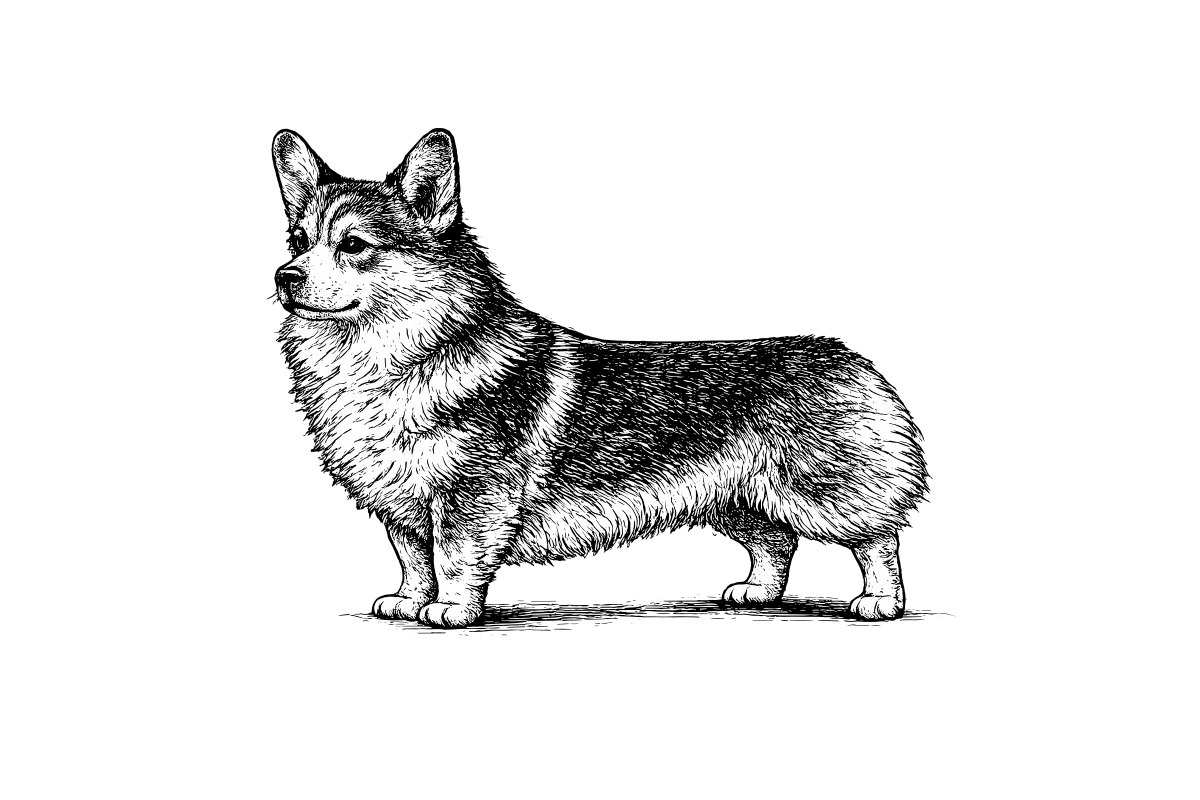
Pembroke Welsh Corgi
Herding group · Pembrokeshire, Wales, 10th century or earlier
One of the oldest herding breeds in Britain and the only one built deliberately short. The Pembroke Welsh Corgi's leg length is not a quirk — it is a herding tool, evolved to put the dog below the arc of a kicking cow's hoof while it bit the animal forward.
Browse the Woodcut Wild shop →Origin & history
The Pembroke Welsh Corgi has been documented in Welsh hill country since at least the 10th century, where it worked as a cattle drover for tenant farmers on common grazing land. The 'corgi' name comes from Welsh: 'cor' (dwarf) plus 'gi' (a soft mutation of 'ci,' dog). The Pembroke and the older Cardigan Welsh Corgi were considered the same breed until 1934, when the Kennel Club formally separated them — the Pembroke is the shorter-tailed, fox-faced variant and the more common today. The breed's modern popularity owes substantially to Queen Elizabeth II, who kept Pembrokes continuously from 1933 until her death in 2022 and owned more than thirty over her lifetime.
Temperament & behavior
Corgis herd by heel-nipping — a quick bite to the back leg of a slow cow, then ducking the inevitable kick. The same behavior applied in a home means they will nip ankles, herd children, and bark at moving feet. They are emphatically not lapdogs; they have the endurance and drive of a full-size herding breed compressed into a 25-pound body. Despite the short legs they are surprisingly fast over short distances and can outwork most larger dogs in stamina.
Originally bred for
Driving cattle by nipping at their heels — the low body kept the dog under the kick line.
Marginalia
- Welsh folklore claims the Corgi was the steed of fairies — the lighter coloring across the shoulders is said to be 'the marks of the fairy saddle.'
- The Pembroke's natural tail is often born docked-looking — a bobtail gene is present in some lines, though most short tails are still surgical.
- Queen Elizabeth II's last surviving Corgis, Muick and Sandy, were given to Prince Andrew after her death.
- Corgis are prone to intervertebral disc disease for the same reason as Dachshunds — the long spine and short legs put unusual load on the back.
Related breeds
Common questions
Do Welsh Corgis shed?
Enormously, far beyond what their size suggests. The double coat sheds year-round and blows out heavily twice a year, and a Corgi produces a volume of hair more befitting a dog twice its weight — owners joke they shed their entire coat continuously. Frequent brushing helps, but the dense undercoat means a Corgi household is a hairy household, no exceptions.
Are Welsh Corgis good with kids and other pets?
Generally good, with a herding-shaped asterisk. Corgis are sturdy, playful, and bold, and they bond well with a family's children and with resident cats and dogs they are raised alongside. The catch is the heel-nipping instinct: a Corgi may try to herd children or a bolting dog by nipping at heels and ankles, and the bold streak means they will stand their ground with dogs many times their size. Early redirection of the nipping is the standard fix.
What health problems are Welsh Corgis prone to?
Backs and weight, primarily. The long spine and short legs make the breed prone to intervertebral disc disease (IVDD) — the same back problem that troubles Dachshunds — and obesity makes it dramatically worse by loading that spine. Corgis gain weight easily and beg persuasively, so keeping the dog lean is the single most protective thing an owner can do. The breed is otherwise fairly hardy.
How much exercise do Welsh Corgis need?
More than the short legs imply — this is a full herding dog in stamina and opinion. A Corgi needs real daily exercise, on the order of an hour of walking and play, plus mental work to occupy the busy mind, or it turns vocal and pushy. The one caveat is the back: keep the activity to running and walking on the flat rather than repeated jumping, which strains that long spine over a lifetime.
How do you protect a Corgi's back?
Keep it lean and keep it off the furniture. The breed's long spine and short legs make weight management non-negotiable — extra pounds load the back directly — and repeated jumping on and off couches or running down stairs adds strain over a lifetime. Ramps, controlled stairs, and a careful diet are the standard preventive measures owners adopt early.