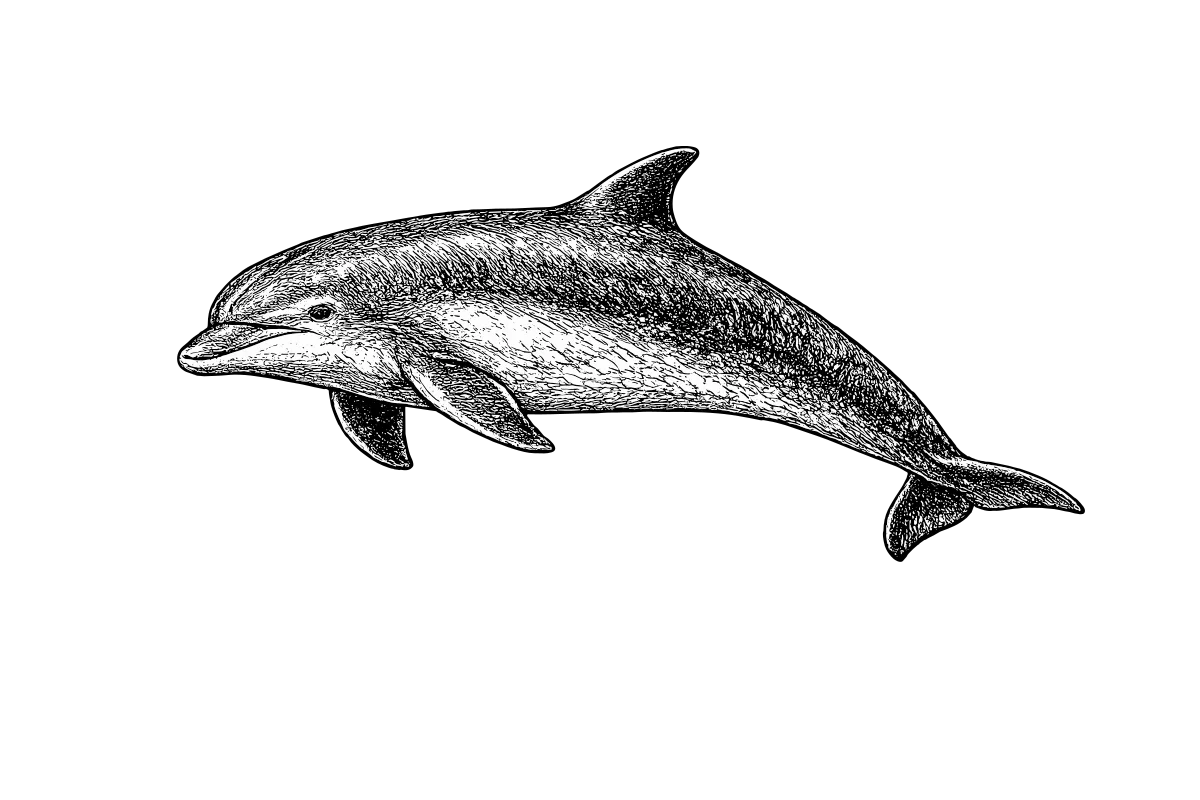
Bottlenose Dolphin
Tursiops truncatus
Among the most intelligent animals in the ocean, and one of the few that appears to recognize itself in a mirror. The bottlenose dolphin uses tools, calls others by name, and teaches techniques across generations — a cultural animal living in salt water.
Browse the Woodcut Wild shop →Habitat
Bottlenose dolphins live in temperate and tropical waters worldwide, in habitats ranging from open ocean to shallow coastal bays, estuaries, and harbors. Coastal and offshore populations differ in size, diet, and behavior, and many coastal groups are resident to a single bay for life.
Behavior
Dolphins live in fluid social groups called pods and hunt cooperatively, sometimes driving fish onto mudbanks or stirring up sediment 'nets.' They use echolocation to find prey, signature whistles to identify one another by name, and have demonstrated tool use — some populations carry sponges on their beaks to protect against abrasion while foraging, a behavior passed from mother to daughter. They are one of very few animals to pass the mirror self-recognition test.
Marginalia
- Each dolphin develops a unique 'signature whistle' early in life that functions as a name — other dolphins will copy and broadcast a specific individual's whistle to get its attention.
- Dolphins sleep one brain hemisphere at a time, keeping one eye open and continuing to surface to breathe — true sleep would drown them, because their breathing is consciously controlled.
- The 'sponging' tool tradition in Shark Bay, Australia is matrilineal — only certain family lines do it — making it one of the clearest cases of animal culture outside primates.
- Bottlenose dolphins have been documented giving themselves a buzz by deliberately provoking pufferfish, apparently using small doses of the fish's toxin recreationally.
Kin & neighbors
Common questions
What is the difference between a dolphin and a porpoise?
Three things: teeth, beak, and fin. Dolphins have cone-shaped teeth, a distinct beak, and a curved, hooked dorsal fin; porpoises have flat spade-shaped teeth, a blunt rounded face with no beak, and a small triangular fin. Porpoises are also smaller, shyer, and rarely ride bow waves the way dolphins famously do. They are separate families that simply look alike from a distance.
How long do bottlenose dolphins live?
Commonly 40 to 50 years, and females longer than males — some studied individuals have passed 60. Researchers age them by counting growth layers in a tooth, much like tree rings, which is also how the long-lived matriarchs of well-studied bays are known by name and history.
How fast can a dolphin swim?
Cruising speed is a relaxed few miles an hour, but in short bursts a bottlenose can hit around 20 mph. They save energy by 'porpoising' — leaping clear of the surface at speed, since moving through air costs less than pushing through water — and by surfing the pressure waves off boats and large whales.
Are dolphins dangerous to humans?
Usually friendly and curious, but they are large wild predators and not the gentle cartoon. Lone 'sociable' dolphins that seek out swimmers have rammed, bitten, and held people underwater, and males can be rough even with their own kind. The standing advice is to admire them from a distance and never feed or crowd a wild one.
What do dolphins eat?
Mostly fish and squid, with the menu shifting by region — mullet, mackerel, and herring in many coastal waters, deeper species offshore. An adult eats roughly 15 to 30 pounds a day, locating prey by echolocation and often herding schools cooperatively before picking them off.