Giant Panda
Ailuropoda melanoleuca
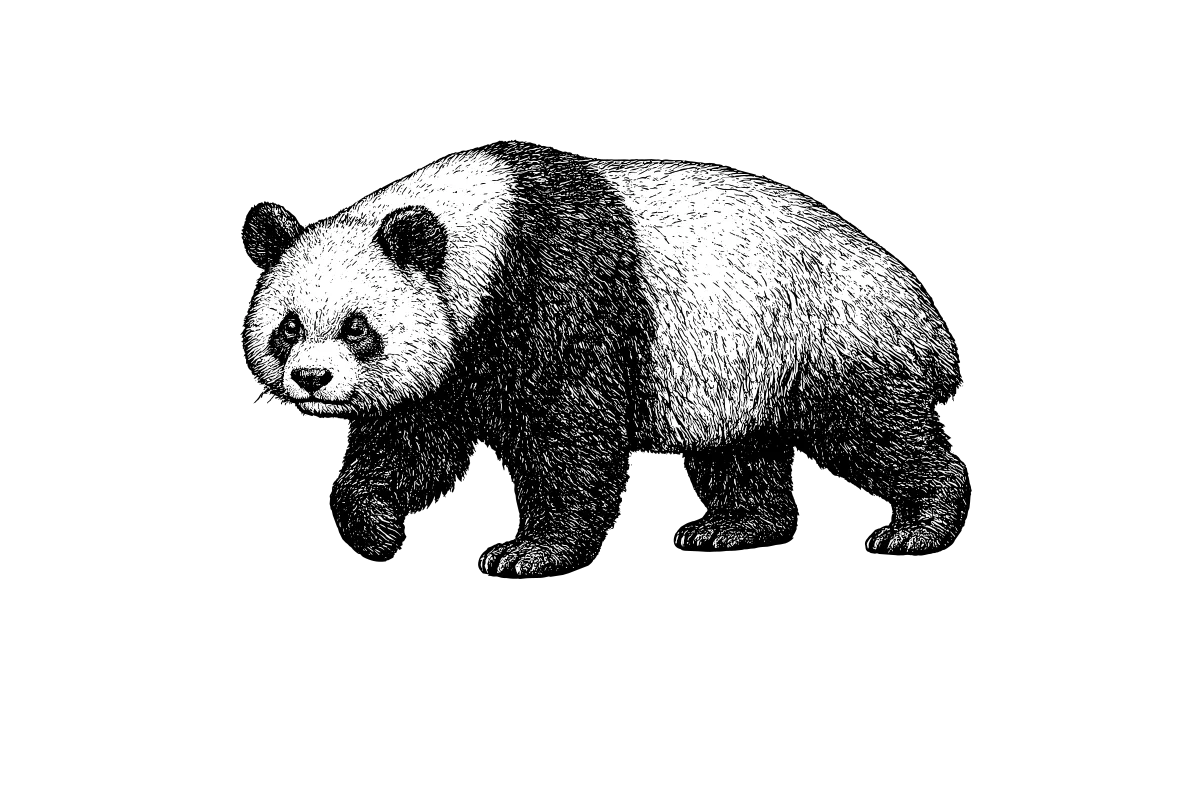
A bear that evolved away from meat. The giant panda spends 10 to 16 hours a day eating bamboo — a low-calorie diet it shouldn't survive on — and has become the global emblem of the conservation movement that quietly brought it back from the edge.
Browse the Woodcut Wild shop →Habitat
Giant pandas live in the mountain bamboo forests of central China — Sichuan, Shaanxi, and Gansu provinces — between 5,000 and 10,000 feet. Their range is fragmented into protected reserves separated by farmland and roads. Outside captivity, fewer than 2,000 remain in the wild.
Behavior
Pandas are bamboo specialists despite being carnivores by ancestry. Their digestive system is poorly suited to plant matter, so they compensate by eating massive quantities — 25 to 80 pounds a day. They spend most of their waking hours sitting upright, gripping bamboo stalks with a 'pseudo-thumb' formed from an extended wrist bone. They are solitary, scent-marking territories with urine and clawing on trees. Cubs stay with their mothers for 18 to 24 months.
Marginalia
- Pandas have one of the lowest reproductive rates of any mammal — females are fertile for only 2–3 days a year.
- Their distinctive black-and-white coloring is thought to serve as both camouflage in snow-dappled bamboo and as a signal to other pandas.
- The giant panda was the original logo of the World Wildlife Fund, designed in 1961.
- China's reserve system has nearly doubled in wild panda numbers since 1980 — one of the great recovery stories in modern conservation.