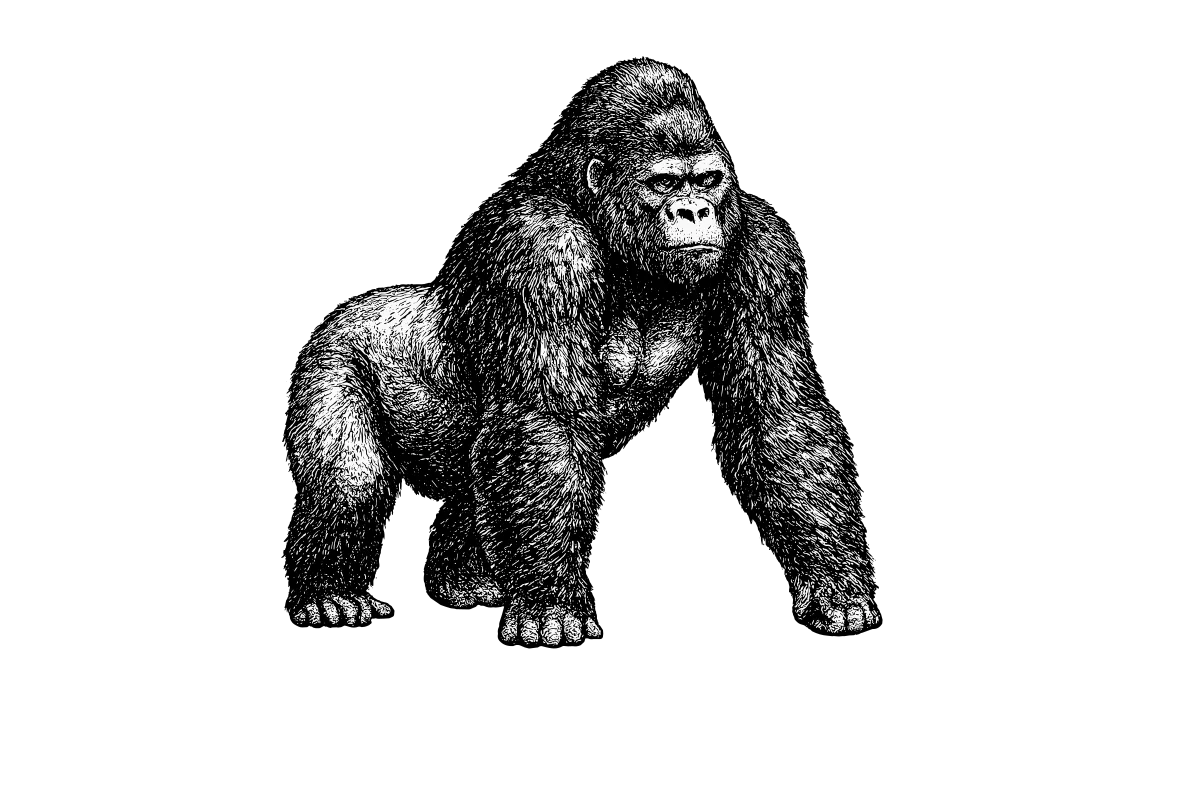
Western Lowland Gorilla
Gorilla gorilla gorilla
The largest primate on earth — silverbacks weigh upward of 400 pounds. Western lowland gorillas live in family groups led by a single dominant male, eat mostly fruit, and share 98% of their DNA with humans.
Browse the Woodcut Wild shop →Habitat
Western lowland gorillas inhabit the dense rainforest, swamp, and secondary growth of the Congo Basin — Cameroon, the Central African Republic, Equatorial Guinea, Gabon, the Republic of Congo, Angola. They prefer flat or rolling terrain with year-round fruit availability and reliable surface water.
Behavior
Gorillas live in stable family groups of 5 to 30 individuals, led by a silverback male. Days are spent foraging — fruit makes up the majority of the diet, supplemented by leaves, stems, and the occasional insect — punctuated by long midday rests. Young gorillas play, learn tool use, and observe the silverback. Communication is rich: gorillas use at least 16 distinct vocalizations and a complex body language. Despite their reputation, they are gentle animals; chest-beating is almost always display, not aggression.
Marginalia
- The Ebola virus has killed an estimated third of the wild gorilla population since the 1990s.
- Gorillas can learn sign language — Koko, the famous captive western lowland gorilla, used over 1,000 signs.
- Adult males develop silver-gray fur across their back and hips as they mature, hence 'silverback.'
- Wild gorillas have been observed using tools — sticks to test water depth and slabs of wood as bridges across boggy ground.