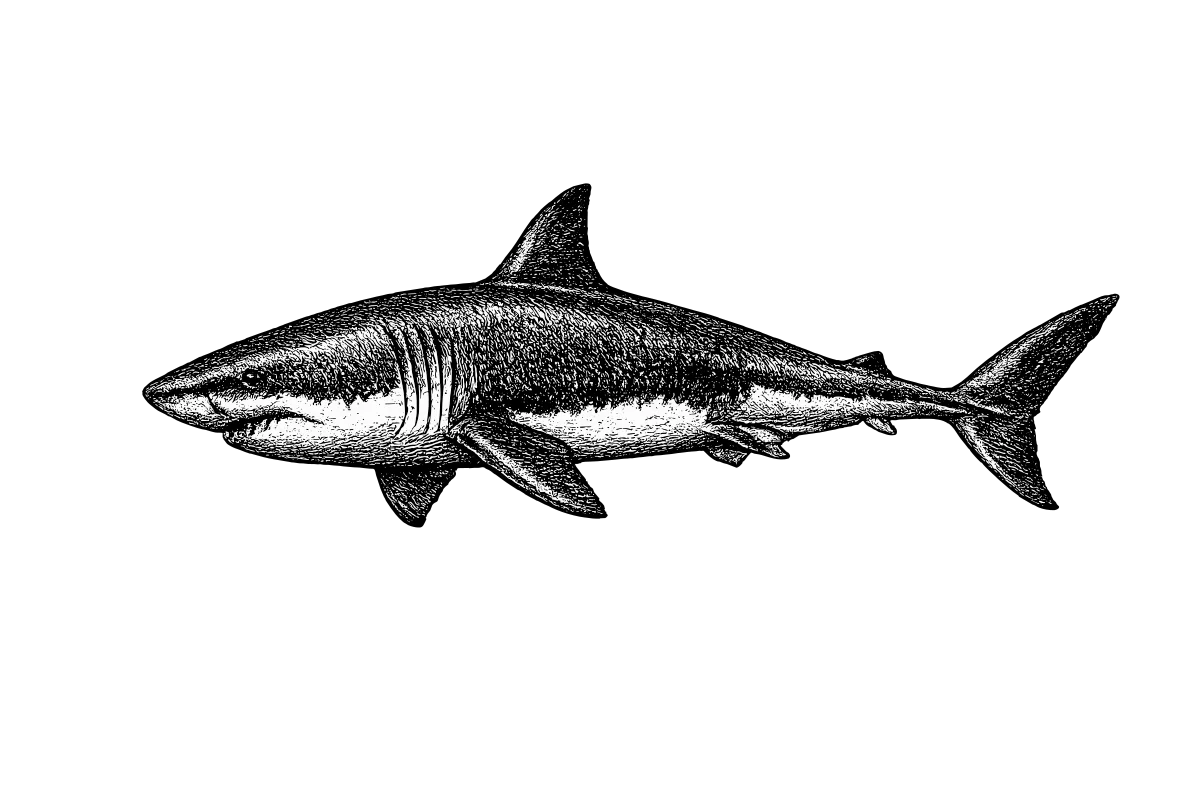
Great White Shark
Carcharodon carcharias
The largest predatory fish in the sea — fifteen feet of muscle, gill slits, and a heat-exchange circulatory system that lets it hunt in cold water. Misunderstood, persecuted, and still very much in charge of its food web.
Browse the Woodcut Wild shop →Habitat
Great whites occupy temperate and subtropical coastal waters worldwide, with hotspots off South Africa, southern Australia, central California, and the northeast U.S. Adults migrate thousands of miles annually between feeding grounds and offshore nurseries. They favor water between 54 and 75°F.
Behavior
Hunting is mostly ambush — great whites attack from below at high speed, often breaching the surface with the prey. They prefer pinnipeds (seals and sea lions) as adults; juveniles eat fish. They are warm-bodied (mesothermic), maintaining a core temperature significantly above the surrounding water, which gives them sustained burst-speed advantages over their cold-blooded prey. They are not solitary in the way once assumed: tagged animals show clear social hierarchies and shared use of feeding grounds.
Marginalia
- Great whites have a sixth sense — ampullae of Lorenzini — that detects the electrical fields produced by every living thing in the water.
- Adults can go weeks between meals; a single seal can sustain a 4,000 lb shark for over a month.
- Despite their reputation, fatal attacks on humans are extraordinarily rare — fewer than 100 confirmed worldwide in recorded history.
- The species cannot survive in captivity for long. No public aquarium has kept one alive past six months.