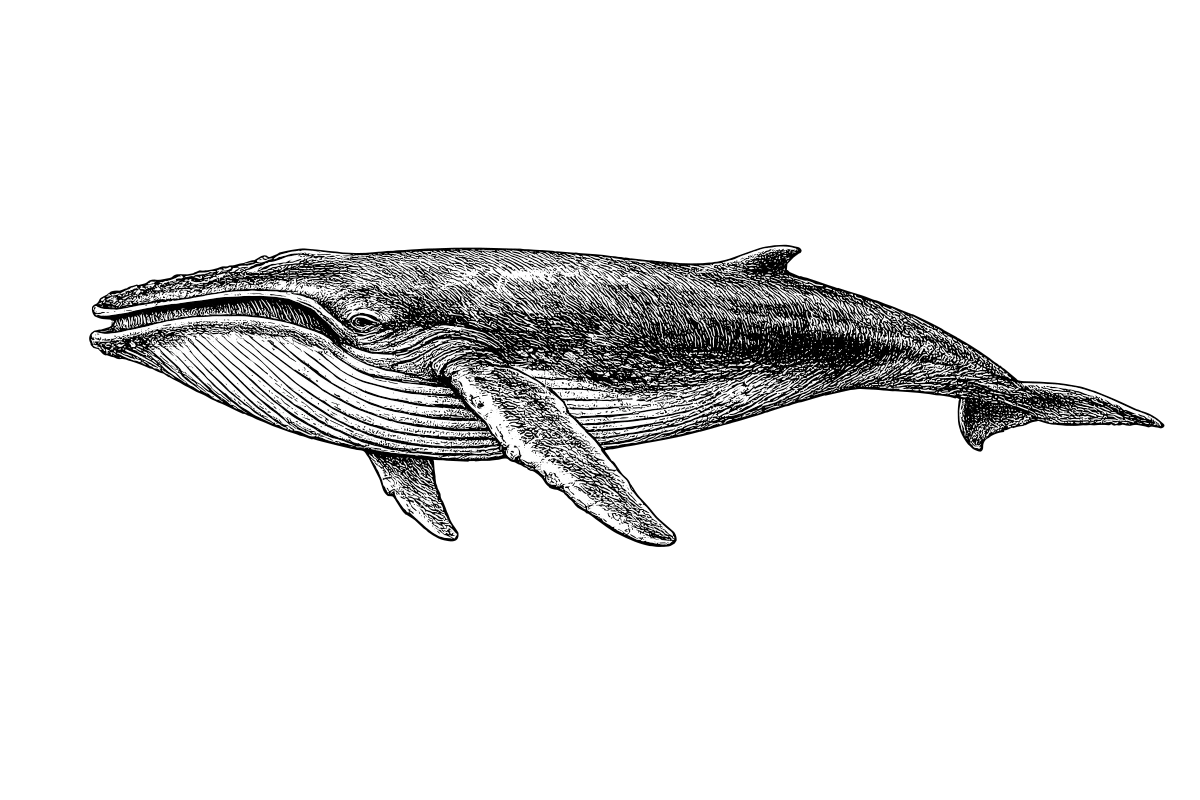
Humpback Whale
Megaptera novaeangliae
A 40-ton animal that sings. The humpback whale produces the longest and most complex songs in the animal kingdom — structured, evolving compositions that spread across ocean basins like hit songs — and makes some of the longest migrations of any mammal to do it.
Browse the Woodcut Wild shop →Habitat
Humpbacks are found in every ocean. They feed in cold, productive high-latitude waters in summer and migrate to warm tropical waters to breed and calve in winter, fasting for months during the breeding season and the migration itself.
Behavior
Humpbacks are baleen whales, straining krill and small fish from the water. Some populations hunt cooperatively using 'bubble nets' — a group blows a spiraling curtain of bubbles to corral fish into a dense ball, then lunges through it. Males sing long, hierarchically structured songs during the breeding season; all the males in a population sing the same song, and that song changes over time and can be transmitted to whales in neighboring oceans. Humpbacks are also famous for breaching, flippering, and tail-slapping.
Marginalia
- Humpback song is genuinely cultural — a new song variant can sweep from a population near Australia eastward across the entire South Pacific over a few years, the largest-scale cultural transmission known outside humans.
- The genus name Megaptera means 'big wing,' for the enormous pectoral fins, which are nearly a third of the body length and used in both swimming and combat.
- Each humpback's tail fluke has a unique pattern of markings on the underside, used by researchers to identify individuals across decades.
- Humpbacks have been repeatedly documented intervening to protect seals and other prey from attacking orcas — apparently deliberate interspecies defense, the function of which is still debated.
Kin & neighbors
Common questions
How long do humpback whales live?
Roughly 80 to 90 years, and possibly longer. Their age can be read from layers in the waxy plug that fills the ear canal, which accumulates like tree rings over a lifetime.
Can a humpback whale swallow a person?
No. A humpback's throat is only about the width of a grapefruit — built to pass krill and small fish, not anything human-sized. The occasional account of a person briefly scooped into a lunging whale's mouth ends with the whale spitting them back out, because there is nowhere for a person to go.
Why do humpback whales jump out of the water?
Nobody is entirely sure, which is the honest answer. Breaching may be communication — the crash is audible for miles underwater — or it may dislodge parasites, or signal fitness, or simply be how a 40-ton animal moves through a moment. Whales breach more in rough seas and during social gatherings, hinting at a signaling role.
What do humpback whales eat?
Krill and small schooling fish such as herring, sand lance, and capelin. They feed almost entirely in summer at the cold poles, gorging to build a blubber reserve, then fast for months through the breeding migration — a humpback may go half the year eating nothing at all.
Do humpback whales have any predators?
Effectively only the orca, and chiefly the calves. Pods of orcas will target a young humpback on migration; the rake-mark scars on many adult flukes are healed evidence of attacks survived. Grown humpbacks are large and powerful enough that most orcas leave them alone.