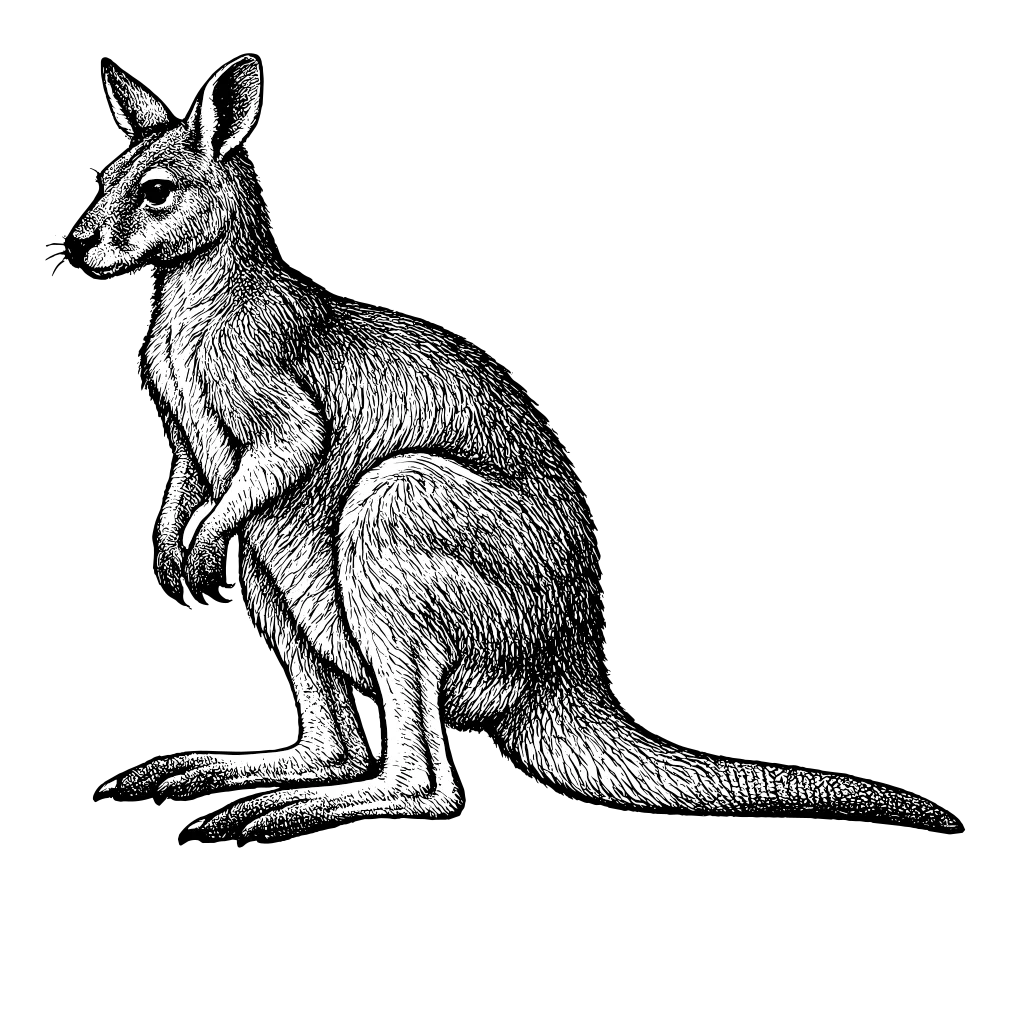
Red Kangaroo
Osphranter rufus
The largest marsupial alive, and the only large animal that hops. The red kangaroo's two-legged bounding is not just a quirk — at travel speed it is one of the most energy-efficient forms of locomotion in the animal kingdom, the tendons in its legs storing and returning energy like springs.
Browse the Woodcut Wild shop →Habitat
Red kangaroos live across the arid and semi-arid interior of mainland Australia — open plains, scrubland, and desert grassland. They are well adapted to drought, ranging widely to find fresh growth after rain and able to suspend reproduction when conditions are poor.
Behavior
Kangaroos graze in loose groups called mobs and are most active at dawn, dusk, and night, resting in shade through the heat of the day. Their hopping gait becomes more efficient the faster they go, because elastic tendons recycle energy with each bound. Males 'box,' balancing on their tails to kick with both hind legs, in contests over females. Females have a pouch and can hold a fertilized embryo in suspended development until an older joey leaves the pouch.
Marginalia
- A red kangaroo can cover 25 feet in a single bound and reach 35 mph, and the faster it hops the less energy each bound costs — the opposite of running.
- Females can carry three young at once at different stages: a joey out of the pouch still nursing, a joey in the pouch, and a dormant embryo waiting to develop — and can produce two different kinds of milk simultaneously for the different-aged young.
- Kangaroos cannot move their hind legs independently on land or walk backward — the inability to go backward is part of why the animal appears on Australia's coat of arms, as a symbol of a nation always moving forward.
- They use their tail as a fifth limb — recent studies show a walking kangaroo's tail provides as much propulsive force as a human leg.
Kin & neighbors
Common questions
What do kangaroos eat?
Grass, almost exclusively. Red kangaroos are grazers built like ruminants on a separate evolutionary line — they ferment fibrous, low-quality forage in a multi-chambered stomach and can go long stretches without drinking, extracting most of their water from the plants themselves.
Are kangaroos dangerous to humans?
Usually not, but a large male can be. A standing red kangaroo is as tall as a person and far stronger, and a cornered one will grapple with its forepaws and deliver a downward kick with both clawed hind legs that can open a serious wound. Attacks are rare and almost always involve animals habituated to people or feeling trapped.
How long do kangaroos live?
Around 8 to 12 years in the wild, and into their early twenties in captivity. Drought, dingoes, and — overwhelmingly — vehicles are the main limits on a wild kangaroo's lifespan.
How big is a newborn kangaroo?
About the size of a jellybean. A red kangaroo is born after roughly a month of gestation as a blind, pink, two-centimeter embryo, and it crawls unaided up its mother's fur into the pouch, where it latches to a teat and finishes developing for months.
Can you keep a kangaroo as a pet?
No, and it is illegal across most of Australia without a license. Kangaroos are wild, powerful animals that grow large, kick hard, and do not domesticate; hand-raised orphans are managed by licensed carers, not kept as household pets.