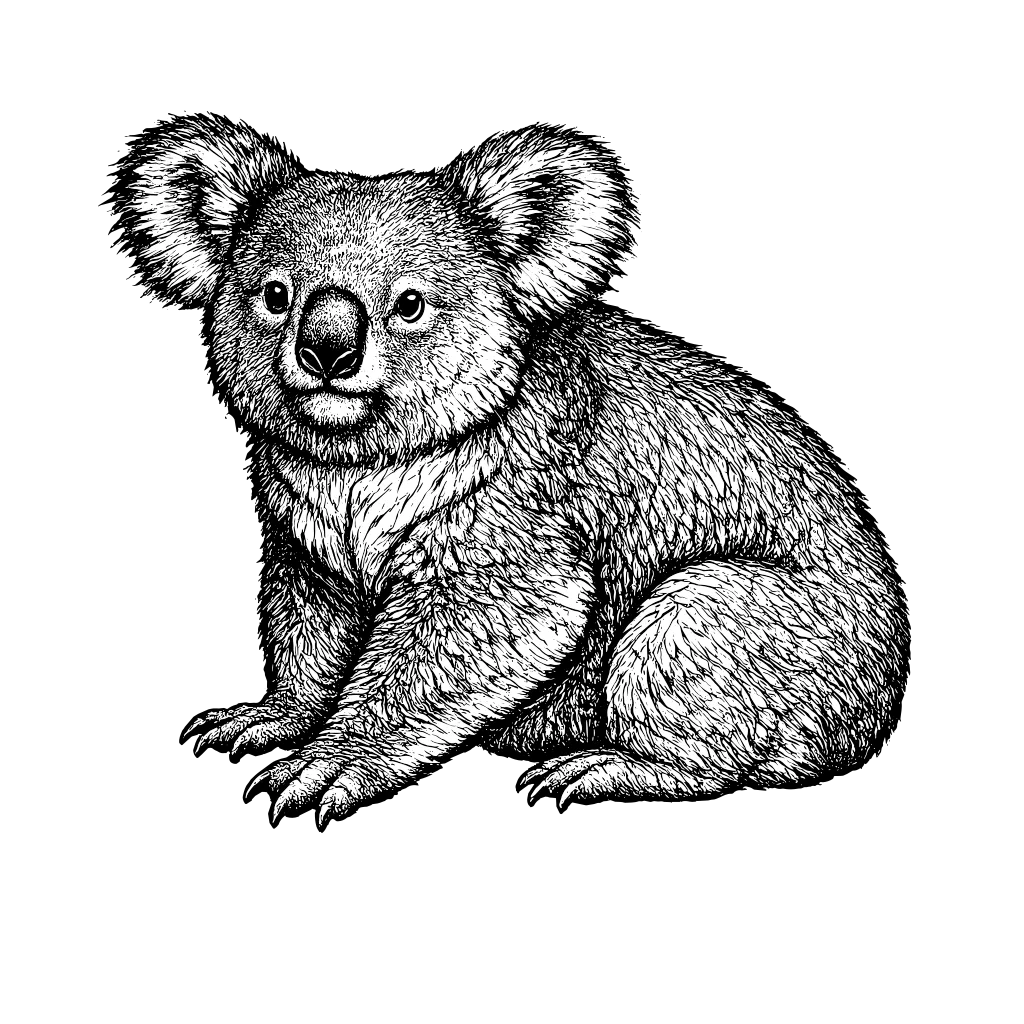
Koala
Phascolarctos cinereus
A marsupial that built its entire existence around a leaf almost nothing else can eat. The koala lives on eucalyptus — toxic, low in nutrition, and indigestible to nearly every other animal — and pays for that exclusive food supply with a life of extreme energy conservation and up to 22 hours of sleep a day.
Browse the Woodcut Wild shop →Habitat
Koalas live in the eucalyptus forests and woodlands of eastern and southeastern Australia. An individual's home range is defined by specific food trees, and koalas are highly selective, eating from only a few of the several hundred eucalyptus species available.
Behavior
Koalas are solitary, sedentary, and almost entirely arboreal, moving between a small set of preferred trees. Eucalyptus leaves are so poor in energy and so loaded with toxins that the koala's whole physiology is built around processing them: an exceptionally long gut, a slow metabolism, and prodigious sleep. They are not bears and are not related to bears; the 'koala bear' name is a colonial-era mistake.
Marginalia
- Koalas have fingerprints nearly indistinguishable from human fingerprints, even under a microscope — a rare case of convergent evolution that has reportedly confused forensic investigators.
- Newborn koalas eat their mother's 'pap,' a specialized form of droppings, to acquire the gut microbes needed to detoxify eucalyptus — they are not born able to eat their only food.
- A koala's brain is unusually small and smooth for its body size, an adaptation to its extremely low-energy diet; energy spent on a large brain is energy a eucalyptus diet cannot spare.
- The species was hunted in the millions for its fur in the early 20th century; public outrage over the koala fur trade was an early catalyst of the modern wildlife conservation movement.
Kin & neighbors
Common questions
Do koalas drink water?
Rarely, traditionally. Koalas get most of their moisture from the eucalyptus leaves they eat, and the name 'koala' is often said to derive from an Aboriginal word meaning 'no drink.' But the picture is shifting: during heatwaves and drought, koalas have increasingly been recorded coming to the ground to drink from streams, troughs, and even bottles offered by people.
What sound does a koala make?
A startlingly deep bellow — a long, grunting, snore-like roar that sounds far too big for the animal. Males produce it in the breeding season, and a special extra set of vocal folds lets a koala pitch the call about twenty times lower than its body size would predict, advertising size to rivals and females in the dark.
Are koalas dangerous, and do they bite?
Generally not, but they are wild animals with long, sharp claws and a strong bite, and a frightened or cornered koala will use both. They are not affectionate by nature; the famous 'koala cuddle' is a stressed animal clinging to the nearest vertical object. Handling wild koalas is restricted in Australia for the animals' sake as much as yours.
How long do koalas live?
Around 10 to 15 years in the wild, with females generally outliving males. Lifespans are shorter where disease, dog attacks, vehicle strikes, and habitat loss take a heavy toll — the leading threats behind the species' vulnerable status.
Do koalas really get high or drunk from eucalyptus?
No — that is a myth. Koalas sleep up to 22 hours a day not because the leaves intoxicate them but because eucalyptus is so poor in energy that extreme rest is the only way to balance the books. They are conserving calories, not nodding off.