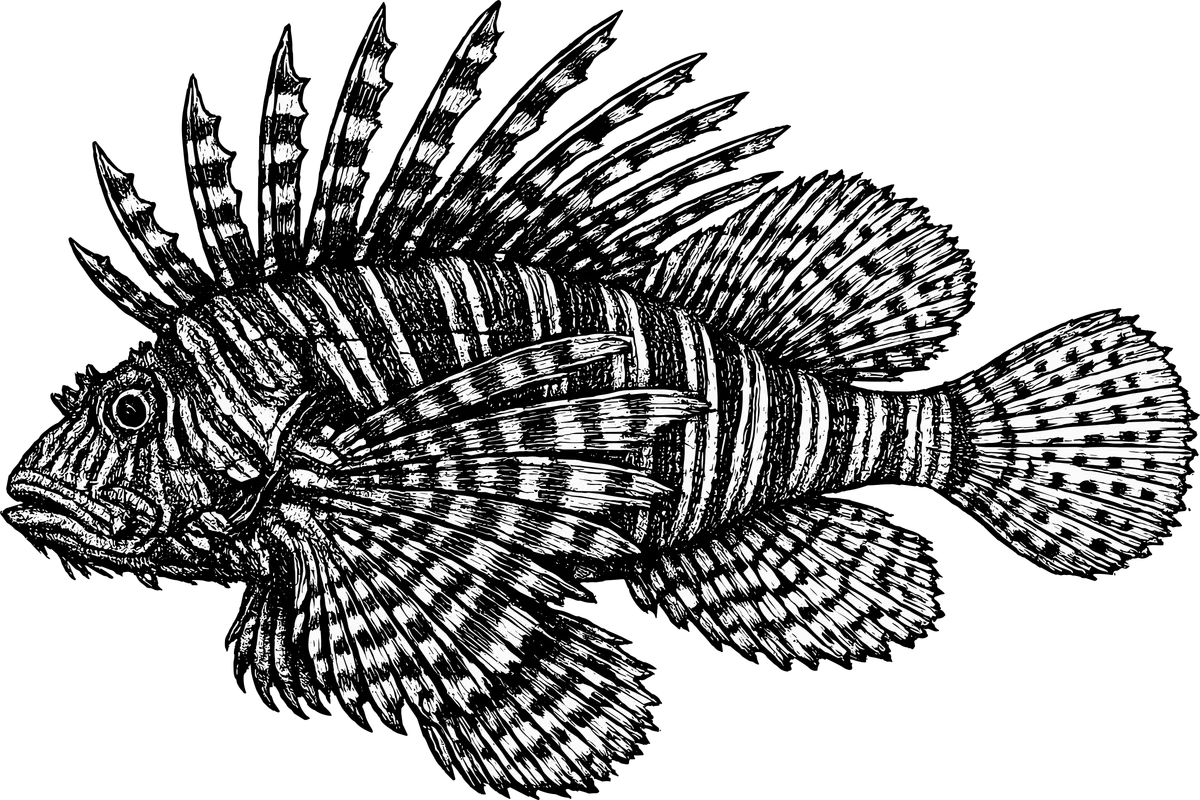
Lionfish
Pterois volitans
Striped, fan-finned, venomous, and beautiful — and in the western Atlantic, an ecological disaster. Native to Indo-Pacific reefs, the lionfish has become one of the most destructive invasive marine species in modern history.
Browse the Woodcut Wild shop →Habitat
Native lionfish inhabit coral reefs, rocky outcrops, lagoons, and seagrass beds across the Indo-Pacific from the Red Sea and East Africa east to French Polynesia. Since the 1980s, invasive populations have established themselves across the western Atlantic — from North Carolina south through the Caribbean and into the Gulf of Mexico — where they now occupy reefs, mangrove edges, and wrecks down to 1,000 feet.
Behavior
Lionfish are slow-moving ambush predators. They drift through the water with elaborate fan-shaped pectoral and dorsal fins outstretched, using the fins to corral small prey into corners before striking with explosive suction. Their dorsal, pelvic, and anal spines (18 in total) carry potent venom that produces excruciating pain in humans but is rarely lethal. The species reproduces explosively: a single female releases two floating egg masses every four days, each containing up to 30,000 eggs. In Atlantic waters, where the species has no natural predators and the local reef fish have no evolved response to the lionfish ambush, this reproductive rate has been devastating — invaded reefs can lose 65% of their small fish biomass within two years of lionfish arrival.
Marginalia
- The Atlantic invasion is believed to have started from a small number of aquarium releases off Florida in the mid-1980s. Genetic analysis suggests the entire western Atlantic population — now in the millions — descends from fewer than 10 founding individuals.
- Lionfish meat is mild, white, and considered excellent eating. 'Eat 'em to beat 'em' has become the primary management strategy in invaded ranges, with annual lionfish derbies, restaurant promotions, and commercial harvest programs.
- The 18 venomous spines deliver intense, hours-long pain when contacted but are rarely lethal to healthy adults. Treatment is immersion of the affected area in hot water, which denatures the venom proteins.
- A lionfish can eat prey up to half its own body length. Stomach-content studies of Atlantic invaders have identified over 70 different prey species, including juveniles of commercially important reef fish like grouper and snapper.
- Lionfish are voracious eaters and grow about 50% larger in invaded waters than in their native range, where competition and predation keep them in check. The Atlantic invasion is, in part, a story of an animal released from the constraints that shaped its evolution.
Kin & neighbors
Common questions
Are lionfish poisonous or venomous?
Venomous, not poisonous — a real distinction. The venom is delivered actively, by the spines, and only the spines; the flesh carries no toxin. That is why lionfish are dangerous to handle but perfectly safe to eat once the spines are removed. Poison would mean they were dangerous to eat, which they are not.
Is it safe to eat a lionfish, and how do you clean one?
Entirely safe, and worth the trouble. The venom is confined to the spines and breaks down with heat, and the fillets themselves were never toxic to begin with. The usual method is to snip off the venomous fin spines with kitchen shears first, then fillet as you would any reef fish — at which point what is left is mild white meat.
How do you catch lionfish?
Mostly by hand, underwater. Lionfish ignore baited hooks, so divers target them with short pole spears or specialized spring-loaded 'lionfish tools,' often containing the catch in a puncture-proof tube. Their habit of hovering slow and unbothered — they evolved without Atlantic predators — makes them easy targets, which is the whole premise of the cull derbies.
What eats lionfish?
In the Indo-Pacific, large groupers, sharks, and other reef predators that grew up alongside them. In the invaded Atlantic, essentially nothing native recognizes them as prey, which is the core of the problem. Efforts to teach Atlantic sharks and groupers to eat speared lionfish have had mixed and controversial results — the most effective predator so far is a diver with a spear.
Can you keep a lionfish in a home aquarium?
Yes, and that hobby is precisely how the Atlantic invasion began. Lionfish are hardy, dramatic aquarium fish, but they grow large, eat tankmates whole, and carry a venomous sting that makes maintenance hazardous. Releasing an unwanted one into the ocean is how a handful of aquarium fish became millions — so don't.