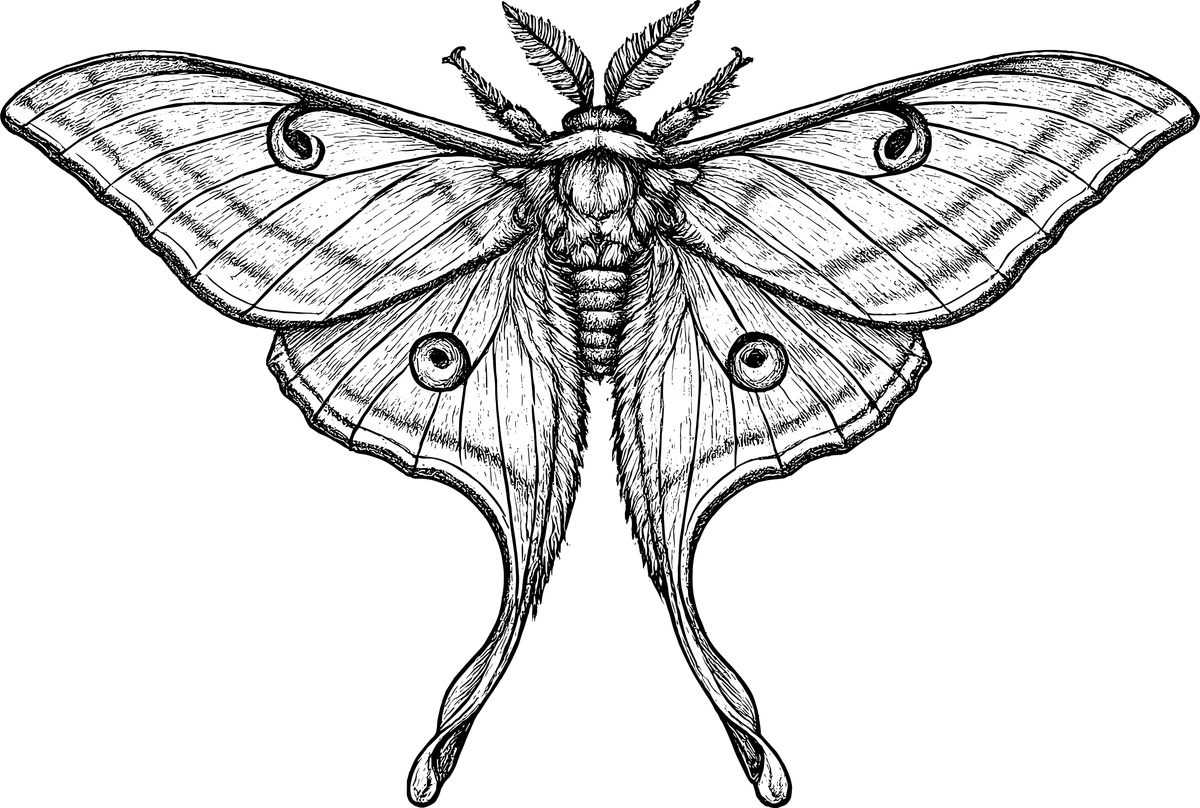
Luna Moth
Actias luna
Pale green, wing-tailed, and built to live a single week. The luna moth is the most striking large moth in North America — a silent night-flier with no mouth, no stomach, and one job.
Browse the Woodcut Wild shop →Habitat
Luna moths inhabit hardwood forests across the eastern half of North America, from southern Canada to central Florida and west to the Great Plains. Caterpillars feed on the leaves of birch, hickory, walnut, sweetgum, persimmon, and several other hardwoods. Adults are nocturnal and short-lived, drawn to porch lights and other point sources from late spring through summer.
Behavior
The luna's whole adult life is a courtship sprint. After emerging from its cocoon, an adult lives only about a week — it has no mouth and cannot eat. Females release pheromones at night that males detect with their feathery antennae from over a mile downwind. After mating, females lay 200–400 eggs on host-tree leaves and then both adults die. The long, twisting tail streamers are an anti-predator adaptation: bat sonar locks onto the spinning tails rather than the moth's body, and the moth escapes while the bat takes a mouthful of wing tip.
Marginalia
- Adult luna moths have no functional mouthparts. They live entirely on the fat reserves built up as caterpillars and die within a week of emerging from the cocoon.
- The long, spinning hindwing tails are an active anti-bat defense — they confuse bat echolocation, so the bat strikes the trailing tails instead of the moth's body.
- Males detect female pheromones at distances over a mile with their elaborate, comb-like antennae.
- Luna moths were once common at porch lights across the eastern United States; populations have measurably declined with light pollution, which disrupts their nocturnal mating flights.
- The genus name Actias is from the Greek for 'shore' or 'beach', and luna is Latin for 'moon' — a reference to the pale, lunar-green wings and crescent eyespots.
Kin & neighbors
Common questions
What does it mean when you see a luna moth?
In folklore the luna moth reads as a sign of rebirth and transformation — a meaning lifted almost directly from its life cycle. It spends months as a caterpillar and a cocoon, then emerges for a single luminous week to mate before it dies. The symbolism more or less wrote itself.
What does a luna moth caterpillar look like?
Fat, bright green, and bigger than people expect — a full-grown caterpillar runs close to three inches. It is ribbed with faint yellow lines and studded with small orange tubercles, and it spends its whole larval life doing little but eating hardwood leaves before spinning down to pupate.
Why are luna moths green?
The green is camouflage. Folded among fresh leaves through the day, a pale-green luna moth all but vanishes from birds and other daylight hunters — its most conspicuous feature doubling as its best defense.
When do luna moths appear?
It depends on latitude. In the North there is a single brood, out for a few weeks in late spring or early summer; further south the moth runs two or three broods, and sightings can stretch from March into early fall.
Are luna moths poisonous?
No — not poisonous, not venomous, and harmless to handle. Neither the adult nor its big green caterpillar carries any toxin, so a curious dog or cat that catches one comes to no harm.