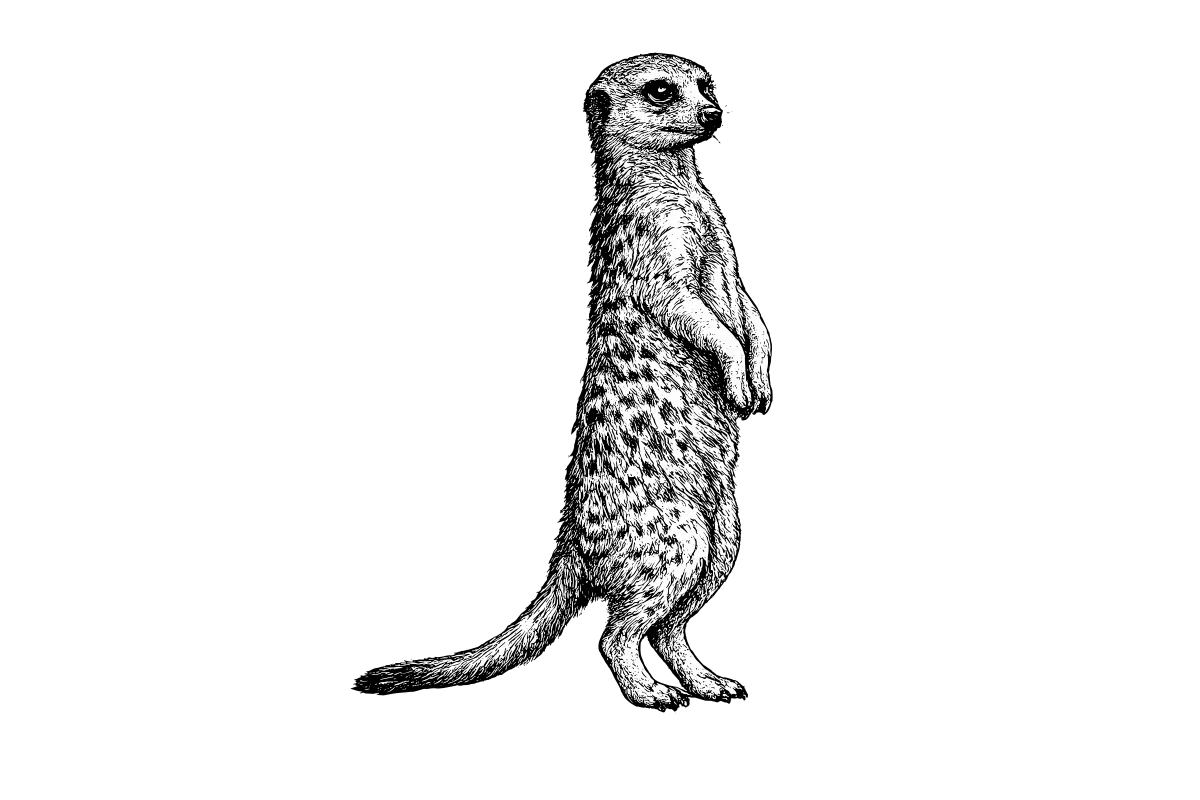
Meerkat
Suricata suricatta
A small desert mongoose that lives in cooperative groups, posts armed sentries while the rest of the mob forages, and is unreasonably good at killing scorpions. The famous upright stance is solar and military at once — warming the dark belly skin in cold morning air, scanning for hawks while it does.
Browse the Woodcut Wild shop →Habitat
Meerkats are obligate desert and dry-savanna animals, found in the Kalahari and other arid regions of Botswana, Namibia, South Africa, and southern Angola. They need open ground with low cover for sight lines, hard-packed soil for the warren systems they share with ground squirrels and yellow mongooses, and a permanent absence of standing water — meerkats drink almost nothing, getting moisture from their prey.
Behavior
A mob of 10 to 30 individuals lives, sleeps, and forages together, with one dominant breeding pair and the rest as helpers. While most of the mob digs through soil for insects, scorpions, lizards, eggs, and the occasional snake, a few sentries take elevated posts and scan the sky and ground, calling specific alarms for specific threats — an aerial predator gets a different call than a ground one, and the mob responds correctly to each. Pups are raised cooperatively, taught to handle scorpions through a graded curriculum of dead, disabled, and finally live prey, and babysat by helpers while their mother forages.
Marginalia
- Meerkats have dark patches around the eyes that work as built-in sunglasses, cutting glare in the harsh Kalahari light and letting them stare directly at the sky to track raptors.
- Their alarm-call vocabulary distinguishes at least four predator categories and three levels of urgency, combinable into more than thirty distinct calls — the kind of structured communication once thought unique to primates.
- A meerkat mob's territory is centered on a complex of burrows shared (and partly built by) ground squirrels and yellow mongooses — the three species cohabit without conflict.
- Pups can begin foraging with the mob at three weeks and are weaned at nine, but they continue to be taught how to handle dangerous prey by adults for months afterward.
Kin & neighbors
Common questions
Are meerkats actually cats?
No — they are mongooses, in the family Herpestidae, more closely related to civets and hyenas than to anything in the cat family. The name 'meerkat' comes from Dutch and Afrikaans and translates roughly as 'lake cat,' which is doubly wrong: the animal does not live near water and is not a cat. By the time anyone noticed, the name had stuck.
Do meerkats really stand watch?
Yes, in shifts, and the role is real. While the rest of the mob forages with their heads down, one or two meerkats climb to an exposed point — a low mound, a termite tower, a thorn bush — and scan for predators. Sentries give different alarm calls for hawks (mob dives into a bolt-hole), for ground predators like jackals (mob flees together to cover), and for snakes (mob mobs and harasses the snake). Sentries are fed in turn by the foragers and rotate the duty.
Can meerkats be kept as pets?
Legally complicated and practically a bad idea. Meerkats are illegal as private pets in most of their native range, in the EU, and in many US states; the demand for them as exotic pets has driven a smuggling problem that is genuinely hurting wild populations. Beyond the legality, a single meerkat raised alone develops severe behavioral problems — they are obligately social — and meerkats spray, dig destructively, and bite when adult. Their charm on screen does not translate to a kitchen.
Are meerkats really immune to scorpion venom?
Resistant, not immune, and the resistance is real. Meerkats handle Kalahari scorpions, including the highly venomous Parabuthus species, by biting off the stinger and crushing the head before eating; an adult that takes a sting will usually survive and recover, where the same dose would kill a dog. Mothers teach pups the technique with disabled prey at increasing levels of difficulty — one of the cleanest examples of teaching documented in a non-human mammal.
Why do meerkats stand upright?
Two reasons at once. The upright posture lifts the eyes above the grass and gives a panoramic view for spotting predators, and the dark, sparsely-furred skin of the belly absorbs morning sun, warming a small desert animal that has spent the night underground. After a cold Kalahari night the mob comes out of the burrow and stands in a line facing east, belly to the rising sun, for several minutes before foraging begins.