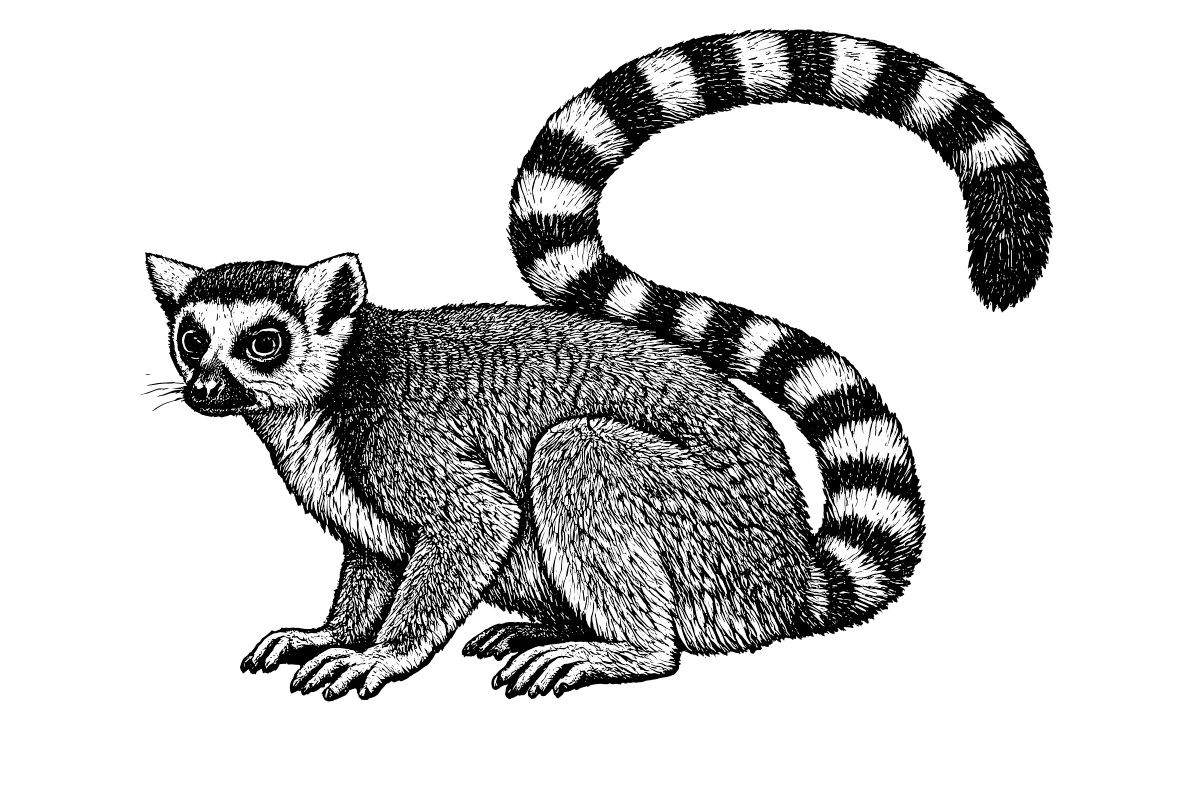
Ring-tailed Lemur
Lemur catta
A medium-sized primate found only on Madagascar, recognizable across a forest at a hundred yards by the long black-and-white banded tail held straight up like a flag. Ring-tailed lemurs live in large matriarchal troops, sunbathe in a yoga pose every morning, and resolve disputes with smelly tail-waving.
Browse the Woodcut Wild shop →Habitat
Ring-tailed lemurs occupy dry deciduous forests, gallery forests along seasonal rivers, and the spiny bush of southern and southwestern Madagascar. They are the most terrestrial of all lemur species — about a third of their time is spent on the ground rather than in trees — and need habitat with both canopy for sleeping and open ground for travel. The total wild range is small, with most populations now confined to fragmented protected areas.
Behavior
Troops of 10 to 30 lemurs are led by a dominant female; females remain in their natal troop for life while males disperse, and every adult female outranks every adult male. The troop forages by day on fruit, leaves, flowers, bark, sap, and the occasional insect, and travels along habitual ground routes between feeding trees. Disputes between males are settled with 'stink fights' — wrist and chest glands rub scent onto the long tail, which is then waved at the opponent like a flag. On cold mornings the troop sits upright facing the sun with arms outstretched, warming the dark belly skin before the day's foraging.
Marginalia
- Ring-tailed lemurs are the only lemurs that habitually sunbathe in an upright, arms-out yoga pose, exposing the dark belly skin to morning sun after a cold night.
- Female ring-tails dominate every male in the troop — they eat first, choose mates, lead group movements, and routinely cuff males out of the way; the matriarchal hierarchy is inherited along the female line.
- Madagascar's lemurs are descended from a small group of African primates that rafted across the Mozambique Channel on floating vegetation roughly 50 to 60 million years ago, then radiated into more than 100 species in isolation.
- The 'stink fight' between males can last up to an hour, with no physical contact — the loser is whichever male's scent-loaded tail proves less impressive.
Kin & neighbors


Common questions
Where do ring-tailed lemurs live in the wild?
Only on Madagascar, and only in a fraction of the island's south. Lemurs as a group are found nowhere else on Earth — they evolved in isolation after Madagascar separated from Africa around 88 million years ago — and the ring-tailed species is restricted to the dry south and southwest, in habitat that has been reduced to roughly a tenth of its original extent by slash-and-burn agriculture, charcoal production, and grazing. The Anja Community Reserve and Berenty Reserve are where most tourists see them.
Are ring-tailed lemurs endangered?
Yes — listed Endangered, with population estimates dropping from perhaps 750,000 in the 1990s to as few as 2,000 to 2,500 in the wild today. The combination of habitat loss, hunting for bushmeat, and capture for the illegal pet trade has been catastrophic in the past two decades, and the species' range is one of the most heavily degraded landscapes in Africa. Captive populations in zoos worldwide are far healthier than the wild one.
Can you keep a lemur as a pet?
Illegal essentially everywhere outside of accredited zoos and research facilities, and a disaster wherever it has been tried. Lemurs are wild primates that require complex social groups, climbing space, sunlight, and a specific diet; pet lemurs develop nutritional deficiencies, aggression, and self-injurious behaviors. Madagascar's domestic pet trade has been one of the largest drivers of the species' decline, and most rescued pet lemurs cannot be returned to the wild. In the US they are illegal in most states under federal primate laws.
Why is the lemur's tail striped?
As a visual signal in dense brush. A troop on the move keeps the tails held vertically — 13 to 14 alternating black-and-white rings on each tail — so that troop members can see each other moving through cover that would otherwise hide them. The tail is also the working part of the male 'stink fight': scent glands on the wrists and chest are rubbed onto the tail, which is then arched over the back and waved like a smelly flag at rivals.
What do ring-tailed lemurs eat?
Mostly fruit and leaves, with the proportions changing across the seasons. Tamarind fruit and leaves are a staple where they grow, supplemented with flowers, bark, sap, and the occasional insect or small vertebrate when easy. The dry-season diet is leaner than the wet, and weight loss across the southern Madagascar dry season is enough that mortality spikes in poor years. They drink standing water when they can and lick it off leaves when they can't.