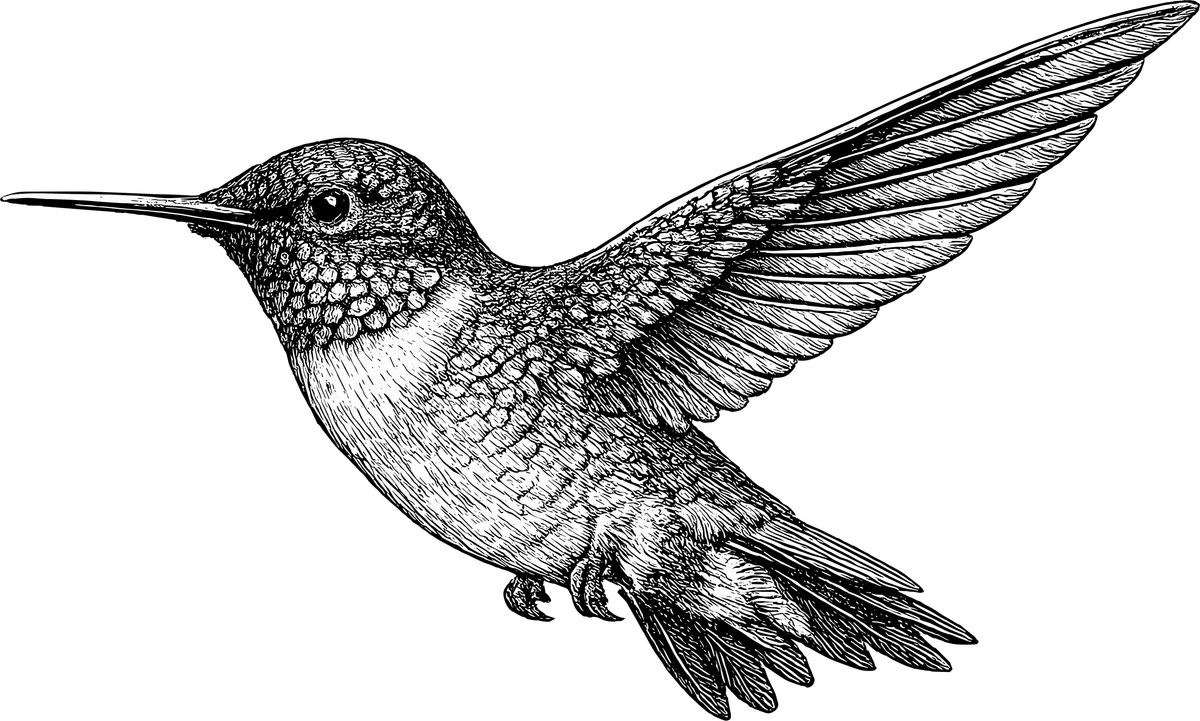
Ruby-throated Hummingbird
Archilochus colubris
The only widespread hummingbird east of the Mississippi. Three inches of iridescent muscle that hovers in mid-air, beats its wings 53 times a second, and flies non-stop across the Gulf of Mexico.
Browse the Woodcut Wild shop →Habitat
Ruby-throats breed in open deciduous woodlands, woodland edges, gardens, and orchards across the eastern half of North America — anywhere there are tubular flowers, small insects, and trees for nesting. They winter from southern Mexico through Costa Rica and Panama. Cultivated nectar gardens and sugar-water feeders have measurably extended their breeding range northward over the last fifty years.
Behavior
Hummingbirds hover by beating their wings in a figure-eight, generating lift on both the down- and up-stroke. They feed on nectar — especially from red, tubular flowers — and pluck small insects and spiders out of the air for protein. Their resting heart rate is around 250 beats per minute and climbs to 1,200 in flight; metabolism is so fast that on cold nights they enter a hibernation-like state called torpor, dropping body temperature by 30 degrees to conserve energy. Males display by diving in 50-foot J-shaped arcs in front of females, with the dive's air resistance making a sharp wing-pitched note.
Marginalia
- Twice a year, ruby-throats fly non-stop across the Gulf of Mexico — 500+ miles in about 20 hours, often doubling their body weight in fat before departure.
- Wing beats average 53 per second; in courtship display dives, the bird can hit 60 mph and pull more g-force than a fighter pilot.
- The male's iridescent ruby throat (gorget) gets its color from microscopic feather structure, not pigment — at the wrong angle it appears black.
- On cold nights, hummingbirds enter torpor: a state of suspended animation where heart rate drops from 1,200 to 50 beats per minute and body temperature falls 30°F. They appear dead until they reanimate at dawn.
- A hummingbird visits roughly 1,000 to 2,000 flowers a day, drinking up to twice its body weight in nectar.