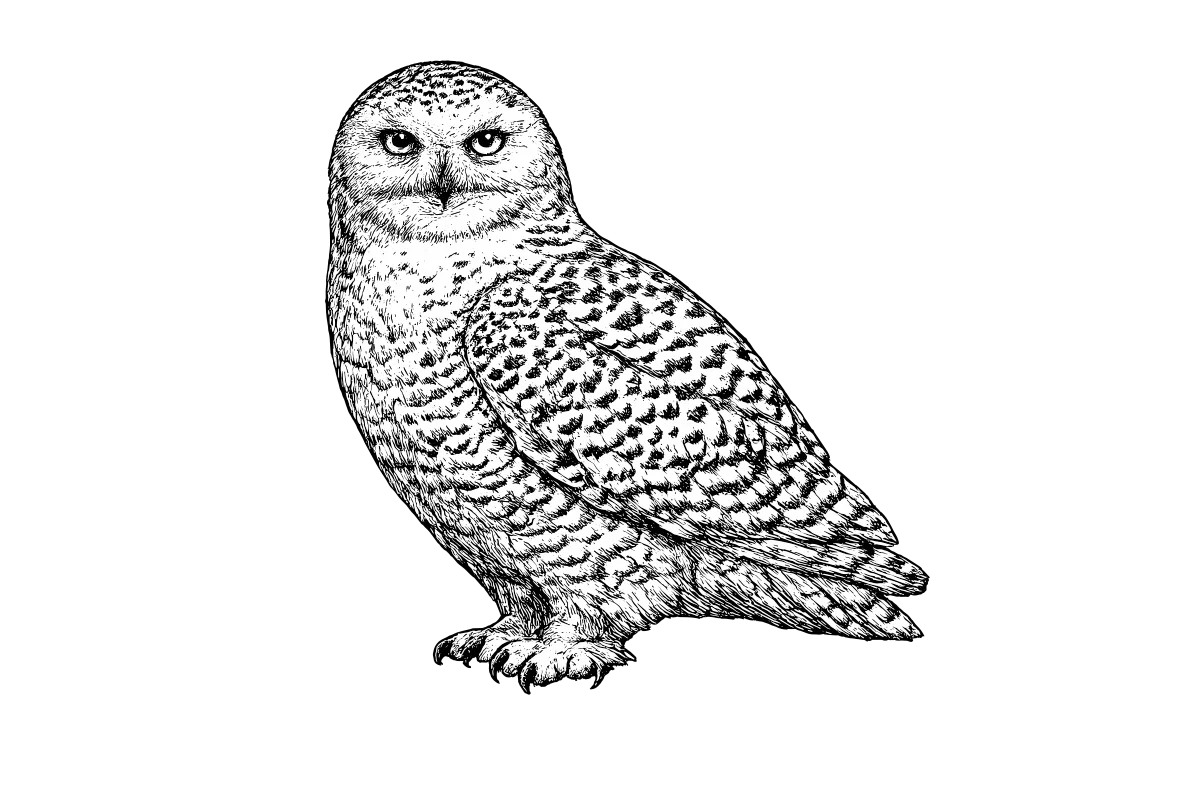
Snowy Owl
Bubo scandiacus
A heavy white owl of the high Arctic that hunts by day, breeds in summers when lemmings boom, and flies south in unpredictable irruptions when the lemming crashes leave it nowhere else to go. The whitest birds — the old males — are nearly pure white; females and young are barred with charcoal across the back and breast.
Browse the Woodcut Wild shop →Habitat
Snowy owls breed across the open tundra of the circumpolar Arctic, choosing low rises and ridges with sightlines across the surrounding ground. In winter most birds remain in the Arctic, but a portion of the population moves south — typically through Canada and the northern US, sometimes as far as the mid-Atlantic — driven less by cold than by the boom-bust cycle of small mammal populations on the breeding grounds. They prefer open landscapes year-round: tundra, marsh, airfield, dune, prairie.
Behavior
Snowy owls are largely diurnal — a necessity in summers above the Arctic Circle, when there is no night to hunt in — and watch for prey from a low perch, then strike with silent flight. Lemmings are the breeding-season staple and the entire reproductive output of the species hangs on lemming abundance: in a peak year a female may lay 11 eggs, in a bad year she does not breed at all. They also take voles, ptarmigan, ducks, hares, and even other owls. Pairs nest on the ground in a shallow scrape, and the female incubates while the male hunts and delivers prey.
Marginalia
- Females are larger than males in nearly all owl species; the snowy owl's reverse size dimorphism is extreme, with females averaging about 50% heavier.
- Old males may be almost entirely white; females and young are heavily barred and become whiter only with age — by sight, a pure white snowy owl is almost certainly an adult male.
- Snowy owls do not build a nest — the female scrapes a shallow depression in the tundra and lays directly on the ground, often atop a wind-scoured ridge with a view in all directions.
- Eggs are laid two days apart, and hatched in the order they were laid — in a poor lemming year the last-hatched chicks starve, and the brood self-trims to whatever the prey base can support.
Kin & neighbors

Common questions
Are snowy owls really like Harry Potter's Hedwig?
Visually close, behaviorally not at all. Hedwig is depicted as nearly pure white, which is accurate for an old adult male; females and young are heavily barred with dark grey or black. More importantly, a wild snowy owl is a temperamental Arctic predator that does not perch on a shoulder, does not deliver mail, and does not adapt to indoor life — the post-Potter spike in pet-owl interest was a small disaster for several owl species in the UK and beyond. They are also illegal to keep as pets almost everywhere.
Where can you see a snowy owl in the US?
The northern Plains, the Great Lakes, and the coast of New England and the mid-Atlantic, in winter — most reliably during an 'irruption year,' when poor Arctic prey conditions push large numbers of young birds far south of the usual range. Logan Airport in Boston and Plum Island in Massachusetts are well-known reliable spots; New York's Jones Beach and the Buffalo and Duluth lakefronts are others. Open flat country resembling tundra is the constant — beaches, dunes, fields, airfields.
Do snowy owls migrate?
Irregularly, and not the way most migrants do. Most snowy owls move only as far as they need to in any given winter to find prey, which often means staying inside the Arctic and shifting from breeding ground to coastal sea ice. Every few years an 'irruption' sends large numbers — especially young of the year — well south of the normal winter range, then they return north in spring. There is no fixed flyway and no calendar; the birds are tracking food, not season.
Do snowy owls hoot?
Rarely, and the call is not the standard owl 'hoot' most people expect. The male's display call is a deep, far-carrying double-noted boom given mostly on the breeding grounds — closer to a foghorn than the rolling hoot of a great horned owl — and outside of breeding season the species is mostly silent. Females and young rarely call at all. The bird in winter on a Massachusetts beach is, in almost every case, watching prey in silence.
Are snowy owls endangered?
Reclassified from Least Concern to Vulnerable in 2017 as long-term population data caught up with reality — the global population is probably under 30,000 and trending down. Climate change is the proximate threat: warming Arctic summers are destabilizing the lemming cycles the species depends on, and ice-free seasons cut off the winter sea-ice habitat that birds use to hunt waterfowl. The species is not endangered in the immediate sense, but the long-term trajectory has worsened materially in the last two decades.