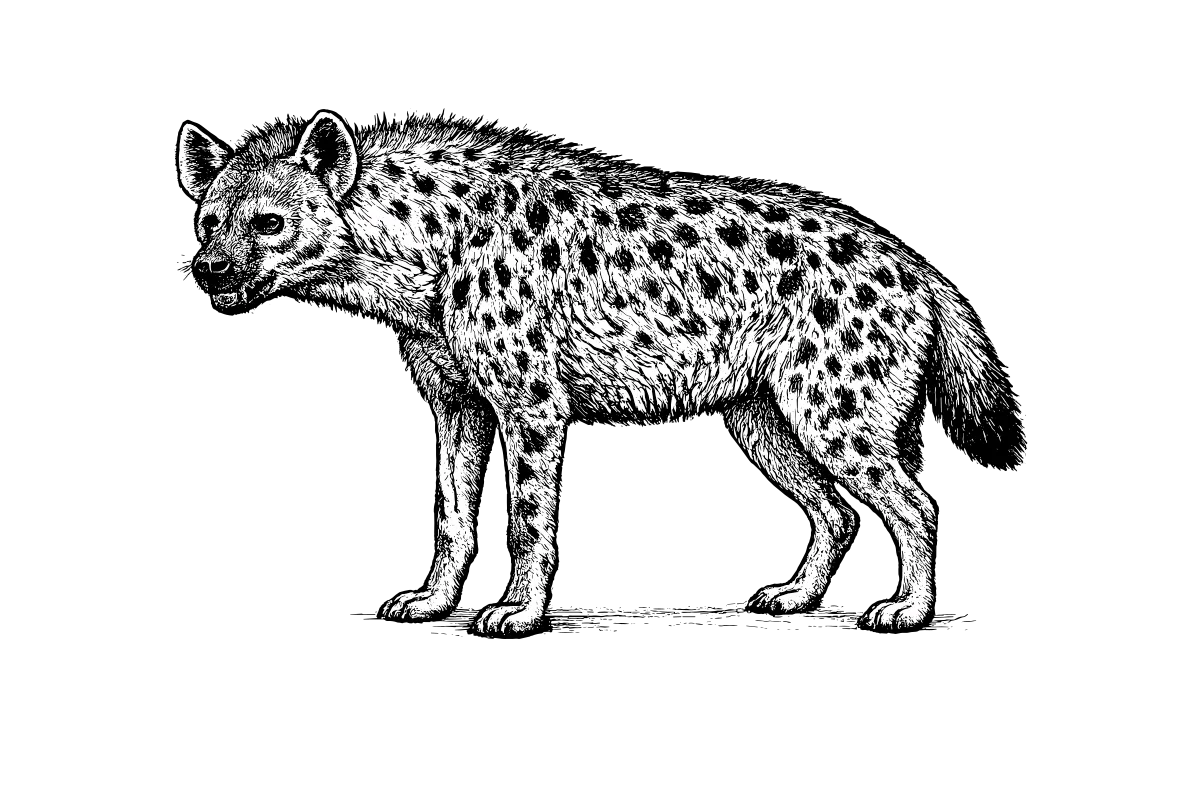
Spotted Hyena
Crocuta crocuta
Africa's most successful large carnivore — not the cowardly scavenger of folklore but a primary predator that kills the majority of what it eats, lives in matriarchal clans of up to 80, and has a jaw built to crush bone the way a nutcracker cracks a walnut.
Browse the Woodcut Wild shop →Habitat
Spotted hyenas range across most of sub-Saharan Africa in any habitat with sufficient prey — savanna, semi-desert, woodland, and the slopes of high mountains up to 13,000 feet on Kilimanjaro. They den in collapsed termite mounds and burrows enlarged by use, and their territories are advertised and policed at the boundaries with scent and patrol.
Behavior
Hyenas live in clans of 6 to 80 individuals organized by a strict matriarchy — every female outranks every male, and rank passes from mother to daughter. They hunt cooperatively, running prey down over distances of three or four miles and pulling adult wildebeest, zebra, even buffalo. Lions take kills from hyenas as often as the other way around; the two are mortal enemies and account for most of each other's natural mortality. A clan communicates through a vocabulary of more than a dozen distinct calls, including the famous 'laugh' (used in social tension, especially around a kill) and the long-distance 'whoop' that travels for miles.
Marginalia
- A spotted hyena's bite force is around 1,100 psi — enough to crush the femur of a giraffe and digest the bone shards into a chalky-white scat unique to the species.
- Hyena cubs are born with eyes open, full teeth, and ready to fight; sibling aggression in the den frequently kills the weaker of a pair, especially when both are the same sex.
- The clan's social hierarchy is so strict that a low-ranking adult will yield food to a high-ranking cub barely a year old, purely on the basis of inherited rank.
- The 'whoop' contact call carries up to three miles and is individually recognizable — a hyena can identify any clan-mate by voice alone.
Kin & neighbors
Common questions
Are hyenas dogs or cats?
Neither, though they share an ancestor with both. Hyenas belong to their own family, Hyaenidae, within Carnivora, and the closest living relatives are the mongooses and civets — not the dogs they superficially resemble. The doggish shape is convergent: hyenas, like wild dogs, evolved a body built for long-distance cursorial hunting on open ground.
Why do hyenas 'laugh'?
It is not amusement. The high, rapid giggle is a stress and submission call, made most commonly during conflict over food — a hyena being shouldered off a kill, a low-ranking female being harassed by a higher one, a youngster pestered by adults. The 'laugh' carries individual identity and rank information, and other clan members reading the call decide whether to come over and join the squabble. The unrelated whoop is the long-range contact call.
Are hyenas just scavengers?
No — and the reputation is largely a colonial myth. Studies in the Ngorongoro Crater and Serengeti show spotted hyenas kill 60 to 95% of what they eat, and that it is often lions who scavenge from hyena kills rather than the other way around. The mistake comes from observing hyenas in daylight, when lions hold the carcasses; at night, when the hyena is the dominant predator, the picture inverts.
Why are female hyenas larger than males?
Because rank is matrilineal and dominance is decided at the kill. A female has to physically out-compete unrelated males at the carcass to feed her cubs, and natural selection has run the species hard in that direction — females average about 10% larger, are more aggressive, and dominate every male in the clan. The pattern is unusual among mammals and is part of why hyena social biology has fascinated researchers for decades.
Is it true female hyenas have a pseudopenis?
Yes — the external female genitalia are formed into a structure functionally and visually similar to a male's penis, through which the female urinates, copulates, and gives birth. The arrangement makes mating and especially first-time birthing extraordinarily difficult, and a significant percentage of first-born cubs (and many first-time mothers) do not survive parturition. Why the species ended up with this anatomy is still being debated; high prenatal androgen exposure is the proximate cause.