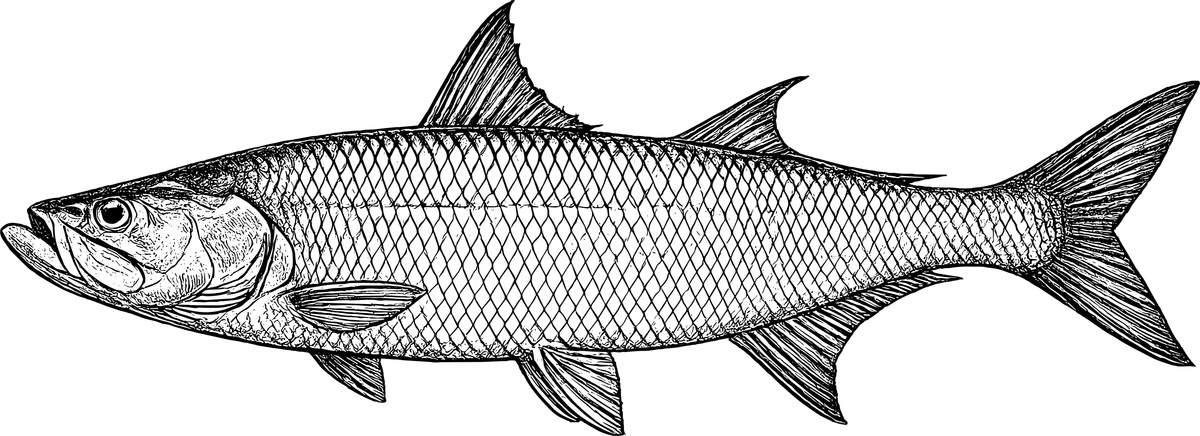
Atlantic Tarpon
Megalops atlanticus
The Silver King. Eight feet of armored, prehistoric fish that gulps air, jumps higher than a fly rod is long, and has held the top of the saltwater fly-fishing pyramid for a hundred years.
Browse the Woodcut Wild shop →Habitat
Tarpon move across a remarkable range of water: tropical and subtropical Atlantic coasts, estuaries, mangrove flats, harbor channels, and freshwater rivers far inland. Juveniles use shallow brackish nurseries — backwaters and salt ponds — where the swim bladder's air-gulping ability becomes critical in low-oxygen water. Adults migrate seasonally along the Gulf Coast, the Florida Keys, the Yucatán, and the Caribbean.
Behavior
Tarpon hunt in loose schools, chasing baitfish at the surface and along structure. They feed by gulping water and prey simultaneously and can be caught on flies, plugs, jigs, and live bait. When hooked, they go vertical — clearing the water in spectacular silver leaps, often three or four in a single fight, head shaking violently to throw the hook. Landing one is more an exercise in attrition than skill. They periodically roll at the surface to gulp air, a sound and a flash of silver that has guided anglers across flats since the sport began.
Marginalia
- Tarpon have a primitive lung-like swim bladder and can gulp air at the surface — an evolutionary holdover that lets them survive in low-oxygen estuary water where most fish would suffocate.
- Individual tarpon have been documented living over 60 years; one captive fish at the Shedd Aquarium lived past 80.
- Their scales are huge — silver dollars, sometimes literally given to anglers as souvenirs after a catch.
- A jumping tarpon can clear six feet of air, and a strong one will jump four or five times in a single fight, often throwing the hook on the descent.
- The 'bony' interior of a tarpon — the head is full of plates — makes hooksets notoriously difficult; pros teach 'bow to the king', dropping the rod tip when the fish jumps to prevent a snapped tippet.