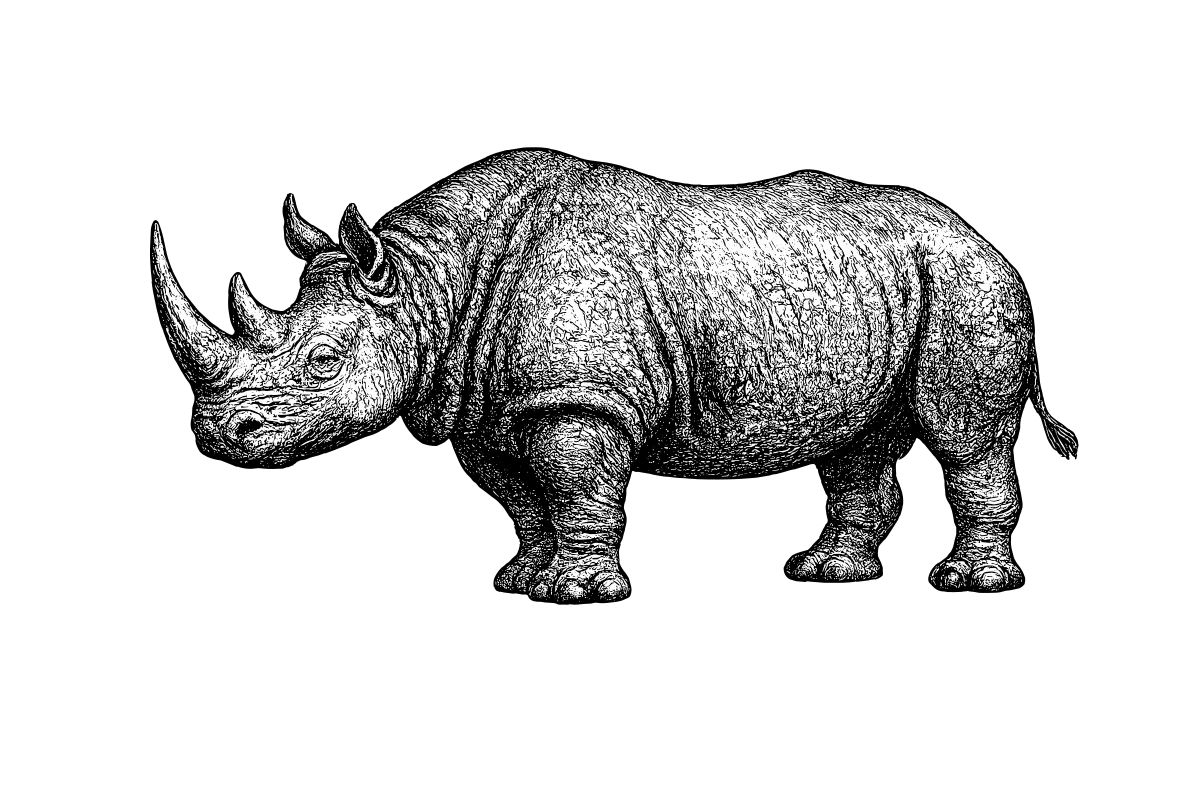
White Rhinoceros
Ceratotherium simum
Three tons of grass-grazing armor. The white rhino is the second-largest land mammal on earth and the great conservation success of its family — brought back from fewer than 100 animals to over 17,000, while three of its four cousins teeter on the edge of extinction.
Browse the Woodcut Wild shop →Habitat
White rhinos live in the savannas and grasslands of southern and east-central Africa, especially South Africa, Namibia, Zimbabwe, and Kenya. They prefer flat-to-rolling country with reliable surface water — they need to drink daily — and short grass for grazing.
Behavior
Unlike the more solitary black rhino, white rhinos are gregarious. Cows and calves form small loose groups; bulls are largely territorial but tolerate other males in their range. The name 'white' is a corruption of the Afrikaans 'wijde' — meaning 'wide' — referring to the broad, square lip adapted for grazing, not coloration. They graze, wallow in mud, dust-bathe, and rest in the heat of the day.
Marginalia
- Rhino horn is made of keratin — the same protein in human hair and fingernails — yet drives a black market valued at over $60,000 per pound.
- The northern white rhino has only two known living individuals, both female. Conservationists are attempting IVF with stored sperm to revive the subspecies.
- Despite their size, white rhinos can run 30 mph in short bursts.
- South Africa, holding 80% of the world's rhinos, lost over 1,000 a year to poaching at the peak of the 2010s crisis.