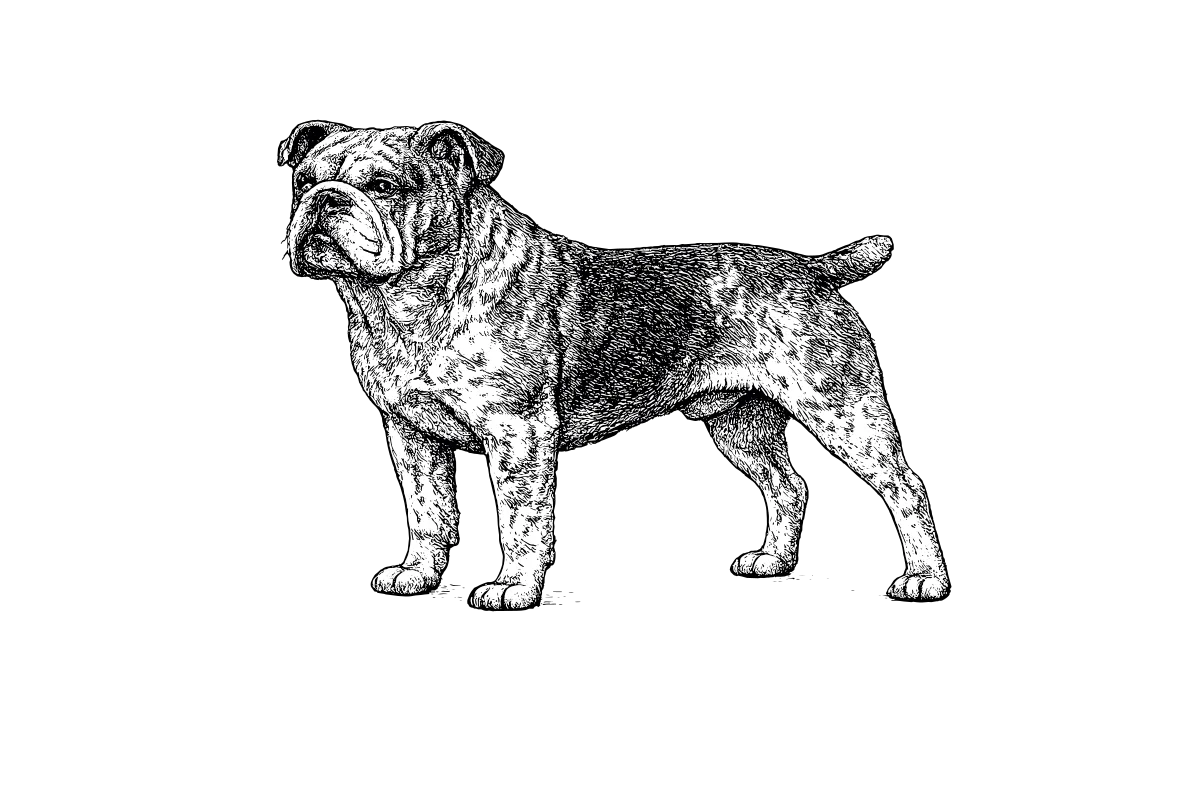
Bulldog
Non-Sporting group · England, 13th century or earlier
The English Bulldog. The breed was engineered for a single illegal blood sport, banned for that sport in 1835, then rebuilt by Victorian fanciers as a household companion in a form that retains the under-slung jaw and barrel chest but discards the working temperament. The result is a calm, low-energy dog with serious health constraints.
Browse the Woodcut Wild shop →Origin & history
The original Bulldog was a working animal — one of the densest, most pain-tolerant gripping breeds ever produced. Bull-baiting was a popular English public spectacle from the 13th to the 19th century: a bull was tethered to a stake, and Bulldogs were released one at a time to seize the bull's nose and hold on while spectators bet on the outcome. The Cruelty to Animals Act of 1835 banned bull-baiting, and the breed nearly disappeared within a generation. Victorian dog fanciers preserved the breed by deliberately breeding away from the working temperament — flattening the face, shortening the legs, and selecting for the placid temperament the modern Bulldog is known for. Almost every modern Bulldog descends from a 1864 dog named King Dick.
Temperament & behavior
Bulldogs are unusually calm for a small/medium dog. They prefer short walks, long naps, and one-room proximity to their household. The breed is brachycephalic to a problematic degree — most Bulldogs cannot whelp naturally (the puppies' heads are too large for the dam's pelvis, so the majority are born by C-section), most struggle to thermoregulate in any heat, and many cannot fly commercially due to in-flight respiratory failure risk. Despite the working origins, modern Bulldogs are extremely poorly suited to physical labor.
Originally bred for
Bull-baiting — gripping the nose of a tethered bull and not letting go.
Marginalia
- The English Kennel Club's 2009 'Bulldog Breed Standard' rewrite was a direct response to BBC documentaries about the breed's chronic health issues — it called for a 'less exaggerated' face and longer muzzle, though the standard remains conservative.
- The Bulldog is the official mascot of the United States Marine Corps; the breed has been a Marine mascot since 1922.
- Modern Bulldogs cannot reliably mate without assistance — the rear hindquarters are too narrow and the front body too heavy.
- Genetic diversity studies have found modern Bulldogs to be one of the most inbred recognized breeds, with effective population sizes that would be considered critically endangered in a wild animal.
Related breeds
Common questions
Do Bulldogs shed?
Moderately, year-round. The short flat coat sheds steadily and needs only weekly brushing, but the real grooming task is the wrinkles — the facial and nose folds must be wiped and dried regularly to prevent skin infection. The tail pocket on some dogs needs the same attention.
Are Bulldogs good with kids and other pets?
Excellent with both, and it is a major reason for the breed's popularity. The modern Bulldog is placid, tolerant, and not easily provoked, so it suits a household with children and tends to coexist peaceably with other dogs and cats. Its low energy means it is more likely to nap through chaos than to add to it.
What health problems are Bulldogs prone to?
More than almost any breed, and the worst of it is structural. The flat face leaves them prone to brachycephalic airway syndrome — labored breathing, snoring, and a dangerous inability to cool themselves, so heat and exertion can be fatal. They are also prone to hip and elbow dysplasia, chronic skin-fold infections, and eye problems, and most cannot whelp without a C-section. Keep them lean, cool, and under a vet who knows the breed.
How much exercise do Bulldogs need?
Very little, and pushing more is dangerous. Two short, cool walks a day is the ceiling for most; the breed overheats and struggles to breathe under exertion, so heat and humidity are genuine hazards. They are built to nap, not to jog.
Are Bulldogs good for first-time owners?
In temperament, yes — calm, quiet, low-energy, and forgiving of a beginner. The catch is medical: the breed's breathing, skin, and heat-regulation problems demand vigilant management and a budget for steep veterinary bills. A first-timer who goes in clear-eyed about the health burden does well; one expecting a low-maintenance dog does not.