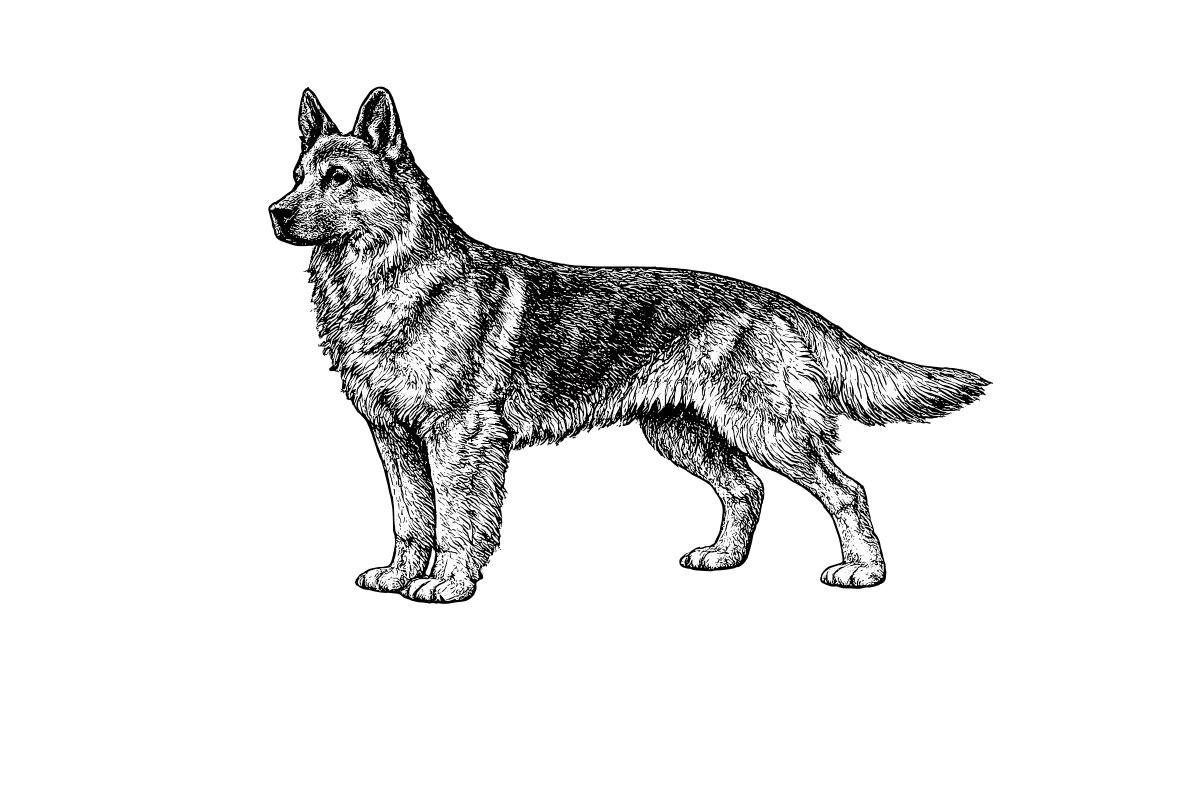
German Shepherd
Herding group · Germany, 1899 (Captain Max von Stephanitz)
The single most consequential dog breed of the 20th century. Developed in 1899 from a deliberate program to consolidate German herding dogs into a working ideal, the German Shepherd became the world's default police, military, and service dog within fifty years of its founding.
Browse the Woodcut Wild shop →Origin & history
The breed was created by Captain Max von Stephanitz, a German cavalry officer who attended a 1899 dog show, purchased a herding dog named Hektor Linksrhein (renamed Horand von Grafrath), and used him as the foundation sire for a new breed. Von Stephanitz wrote the breed standard, founded the Verein für Deutsche Schäferhunde (the breed club, still the largest single-breed registry in the world), and explicitly prioritized working ability over appearance — a principle the German working-line strain still preserves. The breed was used as a military messenger and Red Cross dog in World War I, and its postwar reputation in Britain and the United States was so strong that the breed was renamed 'Alsatian' in the UK until 1977 to distance it from anti-German sentiment. By the 1920s the German Shepherd was the foundational breed for guide-dog programs and police K9 units worldwide.
Temperament & behavior
German Shepherds are unusually focused on a single primary handler — the breed forms tighter and more selective bonds than most. They are wary of strangers without being reflexively aggressive, learn fast, and apply learned behaviors to novel situations more flexibly than most breeds. Show-line and working-line German Shepherds have diverged into nearly distinct populations: show lines are larger, more sloped-backed, and softer in temperament; working lines (often DDR/East German or Czech bloodlines) are smaller, straighter-backed, harder, and overwhelmingly used in police and military work.
Originally bred for
Herding and protecting sheep on German lowlands.
Marginalia
- Rin Tin Tin, the silent-film-era German Shepherd, was rescued from a French battlefield in 1918 by an American soldier and went on to make 27 Hollywood films.
- The sloped 'show-line' German Shepherd back is a 20th-century conformation development; original working dogs had level backs and most working lines still do.
- The breed is responsible for the largest single contribution to the modern domestic dog working-dog gene pool — most contemporary police and military breeds carry German Shepherd ancestry.
- Hip dysplasia is so endemic to the breed that the OFA (Orthopedic Foundation for Animals) was effectively founded around screening German Shepherds in the 1960s.
Related breeds
Common questions
Do German Shepherds shed?
Constantly, and heavily twice a year. The dense double coat sheds year-round — owners call the breed the 'German Shedder' — and blows out in large clumps each spring and fall. Brushing several times a week is necessary just to keep ahead of it; it never fully stops.
Are German Shepherds good with kids and other pets?
Good with their own family's children, and protective of them, though the size and herding instinct mean play with small kids needs supervision. With other animals it depends heavily on socialization: early, thorough exposure produces a Shepherd that coexists calmly with other dogs and household cats, while without it the territorial streak and prey drive can make introductions tense. They tend to bond to their own family and stay reserved with outside animals.
What health problems are German Shepherds prone to?
Hips and joints, above all — the breed is the textbook case for hip and elbow dysplasia, especially in sloped show lines. It is also prone to degenerative myelopathy, a progressive spinal disease, and to bloat (gastric torsion). Buy from breeders who screen hips and elbows.
How much exercise do German Shepherds need?
A great deal, both body and mind. Two or more hours of activity a day is typical, and the breed needs a job — training, scent work, structured play — as much as physical exertion. An under-worked Shepherd grows anxious and destructive; the intelligence demands an outlet.
Are German Shepherds good for first-time owners?
Only committed ones. The breed's size, drive, protectiveness, and need for daily work outpace what many novices expect, and a poorly handled Shepherd becomes a serious liability. A dedicated first-timer willing to train consistently can succeed; a casual one will be overwhelmed.