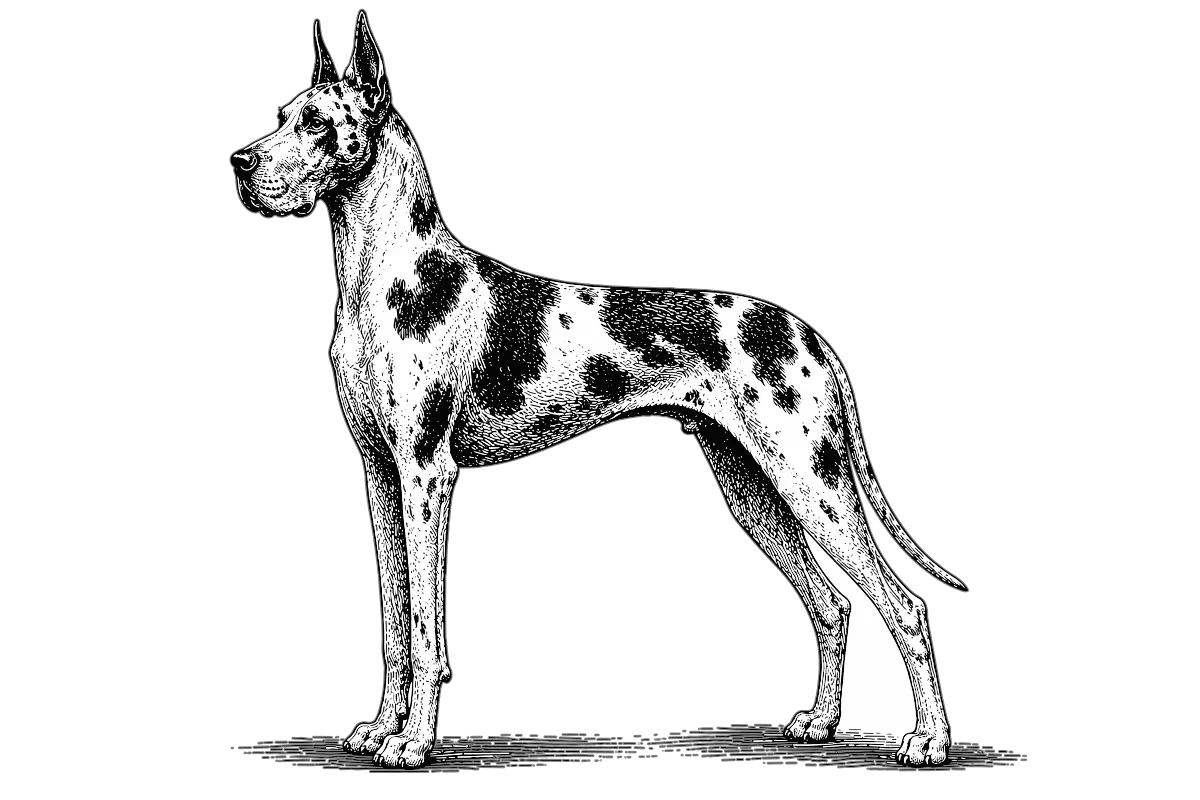
Great Dane
Working group · Germany, 16th–19th century (despite the name)
One of the tallest dog breeds in the world and not Danish in any way. The Great Dane is a German hunting and guard breed, the modern form of which was used by 17th-century European nobility to corner and kill wild boar — an animal that routinely outweighs a human and kills attacking dogs with its tusks.
Browse the Woodcut Wild shop →Origin & history
Despite the name, the breed has no Danish origin. The modern Great Dane was developed in Germany over several centuries by crossing English Mastiff stock with Irish Wolfhound and Greyhound bloodlines, producing a dog tall enough to face a charging boar at eye level. The breed was a status symbol of German nobility from the 16th century forward — Otto von Bismarck kept Great Danes throughout his political career and is said to have insisted on the breed's German identity. The 'Dane' in the English name traces to an 18th-century French naturalist's mistaken classification (Grand Danois) that stuck. Germany officially renamed the breed Deutsche Dogge ('German Mastiff') in 1880 in an attempt to correct the record, but English-speaking countries kept the older name.
Temperament & behavior
Great Danes are remarkably calm for their size and form unusually deep attachments to their household. They are emphatically not low-energy — they require regular long walks — but they are not high-strung either, and the breed standard explicitly calls for a 'spirited but courteous' temperament. The dominant medical concern is the brevity of the life: Great Danes are one of the shortest-lived dog breeds in the world (median lifespan under 8 years), with the size-related conditions of bloat (gastric dilatation-volvulus), dilated cardiomyopathy, and osteosarcoma accounting for most early deaths. Many Great Danes do not survive past six.
Originally bred for
Hunting wild boar; estate guardianship for European nobility.
Marginalia
- The world's tallest-ever dog by Guinness record is Zeus, a Great Dane from Texas who stood 44 inches at the shoulder — roughly the height of a small adult human standing on the floor.
- A Great Dane's resting heart rate can be as low as 40 beats per minute, comparable to a trained athlete's; the cardiac output required to drive a body that large at rest is enormous.
- Scooby-Doo is a Great Dane — the breed was chosen specifically for the cartoon because the producers wanted an animal large enough to comically share a frame with the human characters.
- The breed is one of the few in which a 'merle' or 'harlequin' coat pattern is part of the standard; the harlequin gene is also responsible for serious health issues if two harlequins are bred together (lethal in homozygotes).
Related breeds
Common questions
Do Great Danes shed?
Yes, more than the short coat suggests. There is no long hair to mat and no seasonal coat blow, but a dog this large sheds a steady, fine, year-round stream of short stiff hairs that work into upholstery and weave themselves into clothing. A weekly going-over with a rubber curry brush manages it; grooming is otherwise close to nil.
Are Great Danes good with kids and other pets?
Generally excellent, with the obvious caveat of physics. The breed is patient and gentle with its own family's children, and a Dane raised alongside a cat or another dog treats it as family. The danger is mass, not temperament: a happy Dane swinging its head or backing up can flatten a toddler without noticing, and the hunting ancestry leaves some prey drive toward unfamiliar small animals. The supervision is to protect the smaller party — the Dane simply does not know how heavy it is.
What health problems are Great Danes prone to?
Bloat, heart, and bone — the giant-breed trio. The deep chest makes the Dane highly vulnerable to bloat (gastric dilatation-volvulus), a sudden twisting of the stomach that is a life-threatening emergency; many owners opt for a preventive gastropexy. The breed is also prone to dilated cardiomyopathy, to hip dysplasia, and to osteosarcoma, and these conditions account for most of the early deaths behind its notably short lifespan.
How much exercise do Great Danes need?
A moderate amount, and less than the size implies — but emphatically not none. Two solid walks a day keep an adult Dane content; it is a low-energy houseguest indoors rather than a dog that needs to run. The important caveat is the puppy: a growing Dane's joints are fragile, so forced running, jumping, and stair work should be limited until the skeleton finishes maturing.
How much does a Great Dane cost?
Expensive to buy and far more expensive to keep. A well-bred puppy from a health-tested breeder typically runs well into four figures, but the purchase price is the cheap part — everything scales with the dog. Food bills, giant-breed medication doses, and the standing risk of an emergency bloat surgery costing several thousand dollars make a Dane one of the costlier breeds to own responsibly.