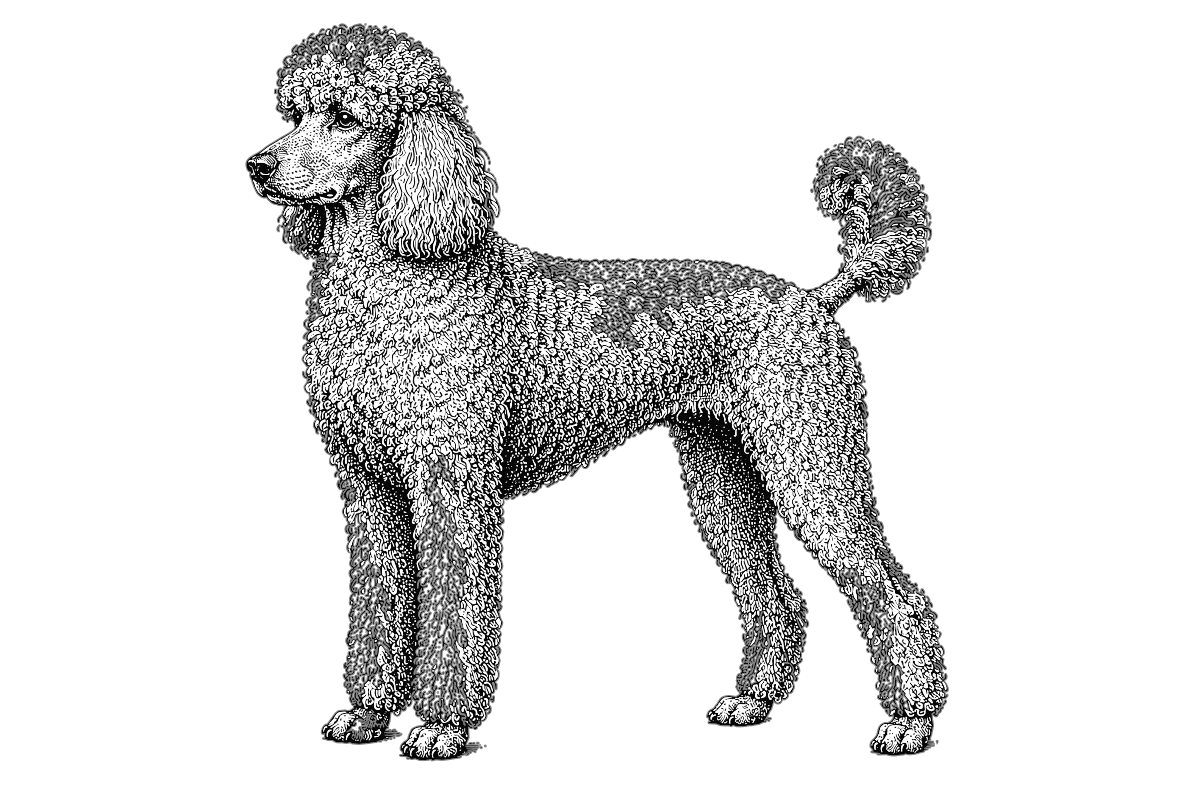
Standard Poodle
Non-Sporting group · Germany (refined in France), 15th–17th century
A working water-retriever in disguise. The Standard Poodle is one of the oldest, most athletic, and second-most-intelligent dog breeds by every measurable test — and the trimmed-and-fluffed image most people associate with it is a 19th-century French show fashion, not anything to do with how the breed worked.
Browse the Woodcut Wild shop →Origin & history
The Poodle is German in origin — the name comes from 'Pudel,' from 'pudeln' (to splash in water) — and was developed as a duck-retrieving gun dog. The breed's elaborate Continental clip, often mistaken for a decorative invention, is a working tradition: the hindquarters and lower legs were shaved to reduce drag in cold water, while the chest, shoulders, and ankle joints were left coated to protect against hypothermia and rheumatism. The French adopted and refined the breed during the Renaissance, and France formally claims the Poodle as the national dog. The Miniature and Toy varieties were bred down from the working Standard in the 18th and 19th centuries for companionship; the Standard remains the original working size. By the 19th century the breed had largely transitioned from gun dog to show dog, but working lines persist and the breed still excels at retrieving.
Temperament & behavior
Standard Poodles are usually ranked second only to Border Collies in canine intelligence testing. They learn commands quickly, generalize well, and are unusual among dog breeds in their capacity for problem-solving and tool-like behavior — opening latches, manipulating objects with their paws, defeating containment systems. They have a single coat (no undercoat), do not shed in the conventional sense, and are often tolerable to mild dog allergies though the breed is not formally hypoallergenic. The breed retains a hunting drive: most Poodles will retrieve enthusiastically and swim without prompting.
Originally bred for
Retrieving downed waterfowl — the breed was a working gun dog before it was a show dog.
Marginalia
- The breed appears in 15th-century German woodcuts wearing essentially the same coat clip seen in modern show rings — the style is centuries old.
- Poodles were used in the French military in both World Wars as scouts, messengers, and (briefly, controversially) parachute dogs.
- Standard Poodles often live longer than other large breeds — a 12–15 year median lifespan is comparable to medium-sized breeds and unusual for a dog of their build.
- The breed has the deepest genetic split between conformation lines and working lines of any retrieving breed — most American Standard Poodles are several generations removed from any working ancestor.
Related breeds
Common questions
Do Standard Poodles shed?
Barely — and that is the breed's headline trait. The single curly coat has no undercoat to blow out and does not shed in the conventional sense; loose hairs tend to catch in the curls rather than fall on the floor. The trade-off is grooming: the coat keeps growing and mats fiercely, so it needs brushing every few days and a professional clip every four to six weeks, and that standing bill is the breed's real, underestimated cost.
Are Standard Poodles good with kids and other pets?
Very good on both counts, and underrated as family dogs because of the foofy reputation. They are patient, playful, and large enough to be sturdy with children, and the high intelligence makes them quick to read a household. They generally do well with other dogs and cats too, though the retained gun-dog drive means a Poodle may chase a fleeing cat. They bond closely and dislike chaos and harsh voices, so they suit a calm, engaged household better than a rowdy free-for-all.
What health problems are Standard Poodles prone to?
Several worth knowing despite the breed's good longevity. Standards are prone to bloat (gastric dilatation-volvulus) owing to the deep chest, to hip dysplasia, and to a few genetic conditions reputable breeders test for — sebaceous adenitis, a skin disorder, and Addison's disease, a hormonal one. They are also predisposed to certain eye conditions. Buying from a breeder who screens for these meaningfully tilts the odds.
How much exercise do Standard Poodles need?
Substantial — remember this is an athletic gun dog under the haircut. A Standard wants a good hour of activity a day and, crucially, mental work to go with it; the breed is too intelligent to be satisfied by a plod around the block. Swimming, retrieving, and dog sports suit them, and a Poodle denied a job will invent its own, usually at the expense of your house.
Are Standard Poodles hypoallergenic?
Lower-allergen than most breeds, but no dog is truly hypoallergenic. The single non-shedding coat keeps loose hair and the dander it carries out of the air far better than a double coat, which is why many mildly allergic people tolerate a Poodle well. It is not a guarantee — allergens also come from saliva and skin — so a sensitive person should spend real time around the breed before committing.