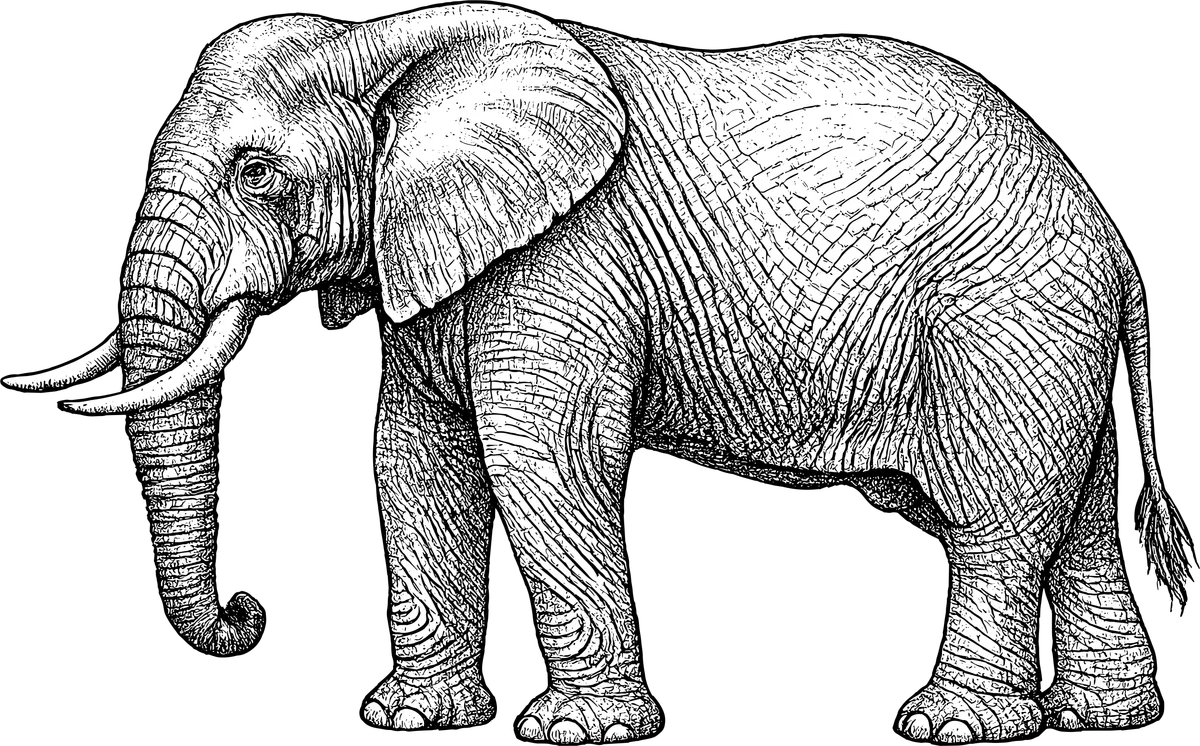
African Elephant
Loxodonta africana
The largest land animal on Earth. Six tons of memory, intelligence, and matriarchal social organization, anchoring the savanna ecosystem and shaping the African continent one mouthful of foliage at a time.
Browse the Woodcut Wild shop →Habitat
African elephants range across diverse habitats south of the Sahara — savanna grassland, mopane and miombo woodland, semi-arid scrub, montane forest, and the dense lowland rainforest of the Congo Basin. Forest elephants (now recognized as a separate species, Loxodonta cyclotis) inhabit the rainforest interior; savanna elephants (L. africana) range the open country of southern and eastern Africa.
Behavior
Elephants live in matriarchal family groups led by the oldest female, who carries the herd's memory of water sources, migration routes, predator behaviors, and other elephants known across decades. Daughters and granddaughters stay with the matriarch for life; bulls leave at adolescence to live singly or in loose bachelor herds. The trunk — a fusion of nose and upper lip with 40,000 muscles — is the most versatile mammalian appendage, capable of stripping leaves from a thorn branch, plucking a single seed, drawing four gallons of water, or lifting a six-ton log. Elephants communicate at distances of up to four miles using infrasonic rumbles below the threshold of human hearing, and they recognize the voices of hundreds of individuals.
Marginalia
- An elephant's trunk has roughly 40,000 muscles — humans have about 600 in their entire body — and can perform fine manipulation (picking up a grain of rice) and brute force (lifting a six-ton log) with the same appendage.
- Elephants communicate across distances of several miles using low-frequency rumbles below the threshold of human hearing. They can also feel these vibrations through the ground via specialized cells in their feet.
- African elephant matriarchs lead family groups for decades, carrying institutional knowledge — water sources, migration routes, drought refuges — that the herd literally cannot survive without.
- Elephants grieve their dead. They return to bones of family members years after death, touching them with trunks and feet, and have been observed standing vigil over a dying herd member for hours or days.
- The trans-Saharan and trans-Atlantic ivory trade has driven elephant populations down by more than 90% since 1900. Recovery has been steady in countries with strong anti-poaching enforcement and community-based conservation; many other range states are still losing animals faster than they're born.