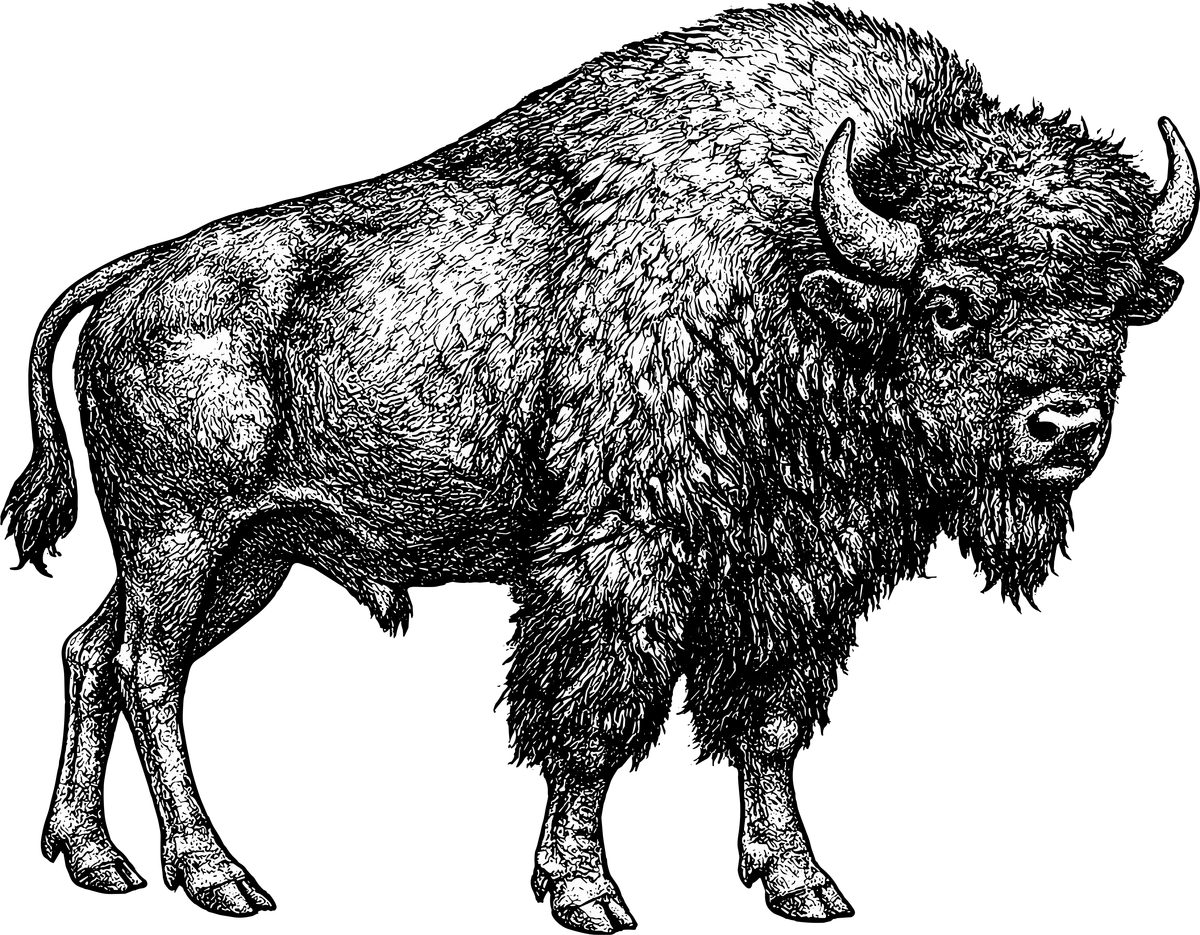
American Bison
Bison bison
The largest land mammal in North America and the national mammal of the United States. Brought back from the brink of extinction in one of the great conservation stories of the modern era.
Browse the Woodcut Wild shop →Habitat
Bison are creatures of open country — shortgrass and tallgrass prairie, sagebrush steppe, river valleys, and open meadows in mountain parks. The wood bison subspecies ranges further into boreal forest and aspen parkland. They need space: large herds historically migrated hundreds of miles a year following the grass.
Behavior
Bison are gregarious grazers, forming nursery herds of cows, calves, and young bulls year-round, with mature bulls living singly or in small bachelor groups outside the rut. During the July–September rut, bulls tend individual cows rather than holding harems, fighting head-to-head in massive contests of weight. They wallow in shallow dust depressions to shed insects and old hair, and use their enormous heads as plows to clear snow from winter forage.
Marginalia
- Designated the National Mammal of the United States in 2016, alongside the bald eagle as a national symbol.
- Pre-colonization estimates put the population at 30–60 million; by 1884, fewer than 325 wild bison remained in the United States.
- Despite their bulk, bison can run 35 mph and jump six feet vertically from a standing start.
- The shoulder hump is solid muscle — it anchors the head and lets the bison swing it like a plow to clear snow from buried grass.
- Often called 'buffalo' in American usage, though true buffalo (water buffalo and cape buffalo) live in Africa and Asia. The name stuck from early French traders calling them les bœufs.