Ground Pangolin
Smutsia temminckii
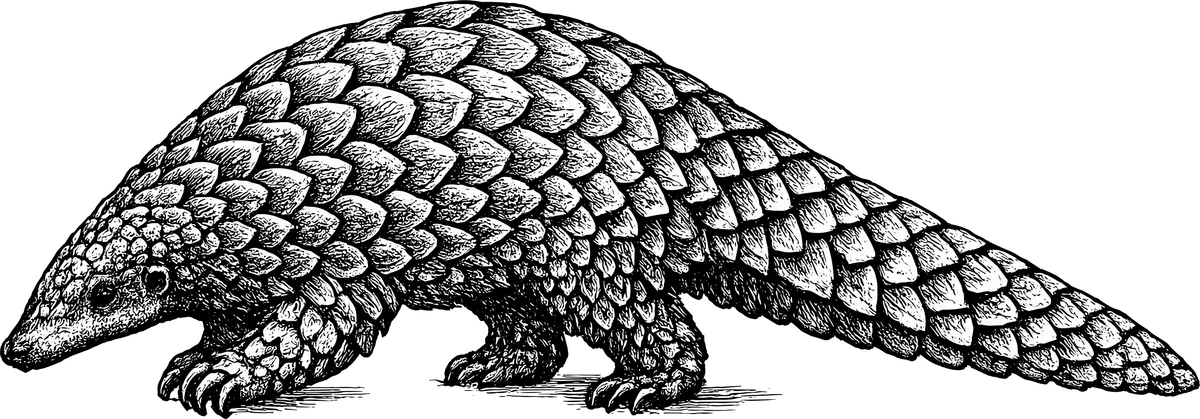
A scaled, ant-eating mammal that walks on its hind legs with a heavy tail as counterbalance. The southern African pangolin — and one of the most trafficked, most endangered, most extraordinary mammals on Earth.
Browse the Woodcut Wild shop →Habitat
Ground pangolins inhabit dry savanna, scrubby grassland, and open woodland across southern and eastern Africa. They avoid dense forest and need soft enough soil to dig — by night for ants and termites, by day for the burrows they sleep in. They will occupy aardvark burrows or excavate their own, sometimes several yards underground.
Behavior
Almost entirely nocturnal and solitary. Ground pangolins walk on their hind legs with the body angled forward and the long, heavy tail trailing as counterbalance, the small forelimbs tucked against the chest. They feed by tearing open termite mounds and ant nests with curved foreclaws and lapping up insects with a tongue that, like all pangolins, can be longer than the body and is anchored deep in the abdomen near the pelvis. When threatened, they curl into a tight ball — overlapping keratin scales facing outward — armor that defeats lions and hyenas but offers no protection against poachers.
Marginalia
- Pangolins are the most-trafficked mammal in the world. Scales are sold into traditional medicine markets despite being made of keratin — the same inert protein as human fingernails.
- Ground pangolins walk bipedally most of the time, using their tail as a counterbalance — a gait shared with very few other mammals.
- A pangolin's sticky tongue is anchored at the pelvis and can extend longer than its head and body combined.
- A single pangolin can consume up to 70 million ants and termites a year, regulating insect populations across its home range.
- The defensive ball, while perfect against natural predators, makes pangolins trivially easy for humans to pick up — a vulnerability that has driven all eight pangolin species toward extinction.