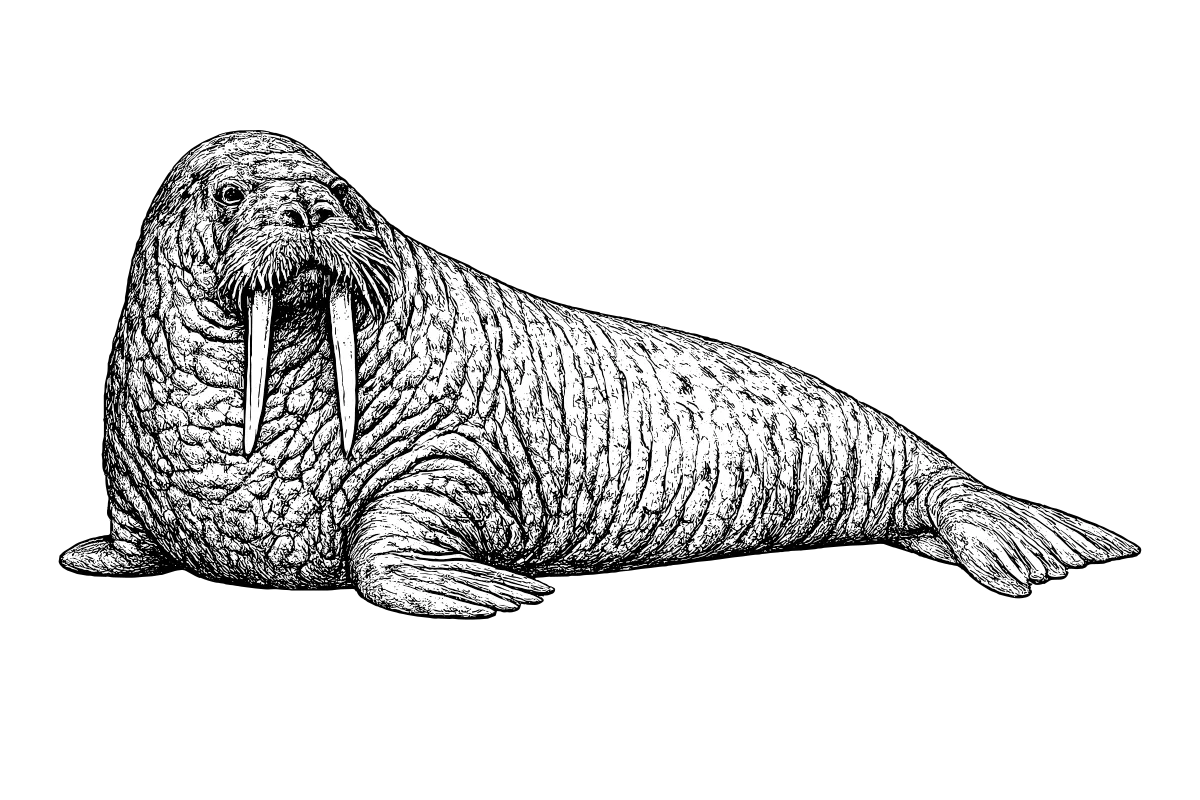
Walrus
Odobenus rosmarus
An Arctic pinniped of impossible-looking proportions — 3,000 pounds of blubber, a forest of stiff whiskers, and a pair of tusks that grow throughout life. Walruses use the tusks like ice axes to haul themselves out of the sea, and the whiskers like fingertips to find clams in seafloor mud.
Browse the Woodcut Wild shop →Habitat
Walruses live around the edges of pack ice across the Arctic Ocean and adjacent seas — the Atlantic subspecies in the Canadian Arctic, Greenland, and the Russian Barents Sea, and the Pacific subspecies in the Bering, Chukchi, and Laptev Seas. They forage on shallow continental-shelf seafloor, rarely diving deeper than 300 feet, and haul out in dense groups on ice floes or, when the ice retreats too far north, on remote stretches of mainland coast.
Behavior
Walruses are bottom feeders, hovering over the seafloor and using the bristled snout and sensitive whiskers (vibrissae) to detect clams, snails, worms, and shrimp in the sediment. A walrus suctions the soft body of a clam out of the shell with a powerful piston-like motion of the tongue and lips, and an adult may eat 4,000 to 6,000 clams in a single foraging trip. They are intensely social, hauling out in mixed-sex groups numbering hundreds to tens of thousands of animals packed in body contact. Bulls hold underwater singing displays around females in winter and battle for breeding access on the ice in spring.
Marginalia
- A walrus's whiskers (vibrissae) number around 400 to 700 per animal and are sensitive enough to identify individual clams buried in seafloor mud, the way a hand identifies coins in a pocket.
- Inflatable air sacs in the throat and esophagus let a walrus float vertically with its head above water to sleep, even in heavy seas, and amplify the underwater bell-and-knock songs males produce in winter.
- Walruses can slow their heart rate to four to six beats per minute on a deep dive, conserving oxygen for the 30-minute hunts on the seafloor.
- The skin on the neck and shoulders of an adult bull is up to four inches thick and covered with thick, knobbly bosses ('bosses') that grow with age and serve as armor in tusking fights.
Kin & neighbors
Common questions
What do walruses use their tusks for?
Three things, none of them digging clams. The tusks are used as ice axes to lever the animal up onto a floe (*Odobenus* means 'tooth-walker'), as weapons in male-male fights and against the occasional polar bear, and as social signals — long, intact tusks indicate age and status in a herd. Both sexes have them. The actual clam-digging is done by the snout and the highly sensitive whiskers; the tusks would be too clumsy and too valuable to grind down in the mud.
Are walrus tusks really teeth?
Yes — they are elongated upper canines, the same teeth that form fangs in most carnivores, grown to enormous size and erupted downward instead of forward. They begin to show at about a year of age and grow continuously throughout the walrus's life, reaching three feet or more in old bulls. They are made of dentin and ivory and were the foundation of a brutal Indigenous and European Arctic ivory trade for centuries.
Do walrus tusks ever grow back?
No. A broken tusk does not regrow, though the remaining stump continues to lengthen from the root. Adult walruses often have one tusk shorter than the other or one snapped off entirely from fighting, ice impacts, or the strain of hauling out — broken tusks are common enough that they're more the rule than the exception in older bulls.
How long do walruses live?
Around 30 to 40 years in the wild, with the oldest verified individuals into their early 40s. Females mature later than most pinnipeds (around 6 to 7 years) and give birth to only a single calf every two to three years — the slow reproductive rate is part of what makes the species so sensitive to ice loss and to hunting pressure.
Are walruses endangered?
Listed Vulnerable, with both subspecies under serious pressure from the loss of summer sea ice. As pack ice retreats north of the continental shelf, walruses can no longer rest on ice between dives over shallow feeding grounds and instead haul out by the tens of thousands on remote mainland beaches, where stampedes triggered by predators or disturbance kill large numbers of calves. The trajectory of the species in this century is essentially the trajectory of Arctic sea ice.